

Author: Julia Blömer
Published on:
Updated on:
Short version:
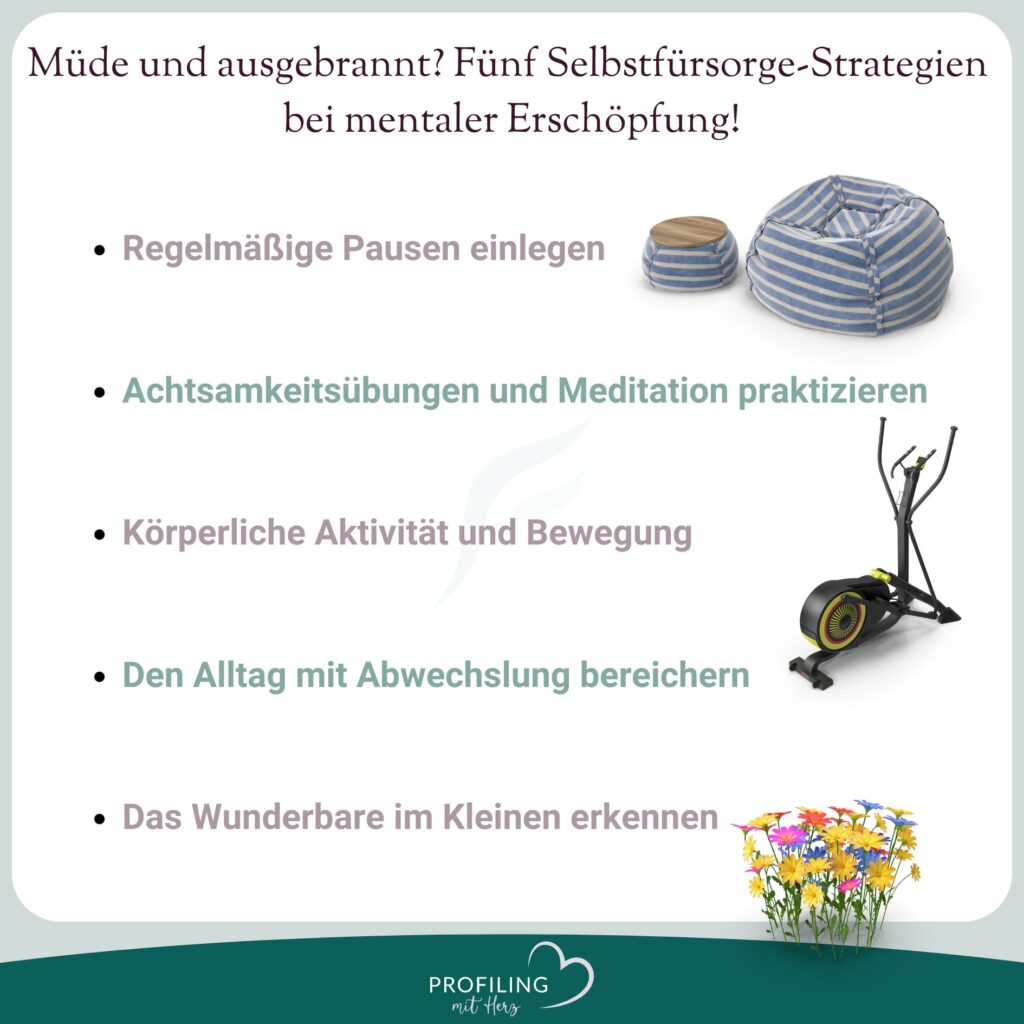
Five self-care strategies:
If you need support, please feel free to sign up for a free initial consultation on. Or just look in our shop, to see if there's something suitable for you.
Do you constantly feel tired, lacking energy, and exhausted? You might be suffering from mental exhaustion. But what exactly does that mean, and how can you deal with it?
Mental exhaustion is more than just normal tiredness. It is a state of profound fatigue that is felt both physically and mentally. It is often the result of persistent stress, High workload or emotional stress. If we are constantly in "survival mode", this can put a strain on our body and mind in the long term.
Symptoms of mental exhaustion can be varied and manifest as sleep disturbances, concentration problems, irritability, depression, or even physical complaints such as headaches and gastrointestinal problems.
Learn more about mental exhaustion and how to manage it to improve your health and well-being.
Now you might be wondering why we're specifically talking about... mental exhaustion in women Studies show that women are more frequently affected by mental exhaustion than men. This can be attributed to the double burden of career and family, high self-expectations, and the pursuit of perfection.
Furthermore, women tend to put their own needs last and focus on the well-being of others. However, this selflessness can lead to them neglecting themselves and depleting their energy reserves.
It's important to pay attention to your needs and develop strategies to manage stress and recharge your energy. In this blog post, we present helpful tips and techniques to bring more self-love, harmony, joy, and ease into your life.
You deserve to feel good and full of energy. Energy and zest for life to be! Learn how you can better meet your needs and reduce stress to lead a fulfilling and happy life.
Overload, stress and perfectionism – these challenges are familiar to all of us, both in our private and professional lives.
But how does being overwhelmed affect us? Negative thoughts and exhaustion creep in, and we feel trapped in a downward spiral with no way out. Learn how being overwhelmed, stress, and perfectionism can affect your well-being.
Only by correctly interpreting your physical and mental signals can you effectively counteract them. Mental exhaustion It often manifests itself through a variety of physical and emotional symptoms. You might experience constant fatigue despite getting enough sleep. Difficulty concentrating and feeling overwhelmed by simple tasks are also possible signs.
Emotionally, you could unsatisfied, You may feel irritable or anxious. You might find less enjoyment in activities you used to enjoy. You may withdraw from friends and family and prefer to isolate yourself. Additionally, you may experience... unhappy in his job are.
These symptoms are important indicators that your body and mind are out of balance. They are a sign that you should slow down and take time for yourself. Trust these signals and take care of your well-being.
You may have already heard of Burnout You've heard of it and are wondering how it differs from mental exhaustion. Both conditions are characterized by chronic stress, but there are differences. Mental exhaustion is often a precursor to burnout. It's a state of deep tiredness and exhaustion that can last for weeks or even months. However, if you continue to be exposed to high levels of stress without taking steps to care for your mental health, it can lead to burnout.
Burnout is a state of chronic physical and emotional exhaustion, often accompanied by cynicism, feelings of alienation, and ineffectiveness at work. It is the end stage of prolonged overexertion and can have serious health consequences.
It is important to recognize the signs of mental exhaustion and take measures to counteract them before they result in burnout.
Recognizing the Warning signs Recognizing signs of mental exhaustion is crucial. These signals act like an alarm system, indicating that we need to take steps to prevent burnout.
Warning signs can include persistent fatigue, sleep problems, reduced performance, and difficulty concentrating. You may feel emotionally unstable, irritable, or easily overwhelmed. You might also withdraw more and more and avoid social contact.
Recognizing warning signs early is the first step in preventing burnout and intervening in time. The sooner you act, the greater your chances of regaining your balance and reclaiming your energy and zest for life.
If you notice these warning signs, it's important to seek help. This might mean talking to a trusted friend or family member, seeking professional support, or making sure you have enough time for yourself and to relax.
It's crucial to take your feelings seriously and listen to your body. You deserve to take care of yourself and ensure your well-being. In the following sections, we'll discuss how you can build resilience and boost your self-esteem to combat mental exhaustion and lead a happier, more fulfilling life.
Strengthening resilience and boosting self-esteem to combat exhaustion and lead a happier life. Get support from friends and experts and find time for relaxation and self-care.
In a world that constantly demands perfection, accepting ourselves as we are can be a real challenge. Nevertheless, self-acceptance plays a crucial role in overcoming mental exhaustion.
Self-acceptance It means acknowledging and valuing yourself deep down, including all your weaknesses and flaws. Accepting your own humanity and acknowledging that you can't always meet everyone's expectations are crucial for our mental health.
Without self-acceptance, we often get caught in a vicious cycle of self-criticism and negativity, which exacerbates our mental exhaustion. It's important to reduce the pressure we put on ourselves to meet high standards. By allowing ourselves to simply be ourselves, we can conserve our energy and find a genuine sense of fulfillment.
Self-acceptance – a balm for the soul. When we accept yourself, We become kinder and more understanding towards ourselves. This relieves stress and allows for relaxation and regeneration.
This also means taking breaks and paying attention to our needs. We learn to respect our limits and say no when we are overwhelmed. This creates space for recovery and recharges our energy reserves.
Self-acceptance helps us set realistic goals and develop healthy habits. Instead of constantly criticizing ourselves, we encourage and reward ourselves. This fosters a positive self-image and gives us the energy and motivation to keep going, even when things get difficult.
In the following sections, we will present practical exercises and techniques to improve the Self-acceptance to strengthen and combat mental exhaustion. Because everyone deserves to be loved and respected just as they are!

In this blog post, we have discussed the topic in detail:„mental exhaustion“We discussed this topic in detail. We explored the importance of self-acceptance and its role in coping with mental exhaustion. We recognized the importance of recognizing our body's warning signals and responding to them promptly to prevent burnout.”.
In addition, we have presented five self-care strategies that can help you rebuild your energy: regular breaks, mindfulness exercises, physical activity, variety in everyday life, and consciously enjoying the little pleasures of life.
It is of great importance for women to pay attention to their mental health and to integrate these self-care practices into their daily lives. self-love Developing yourself is not selfish, but essential. You deserve to feel good and You don't have to please everyone..
With our unique method „Profiling with heart“ We combine scientific precision with empathy. We accompany you on your path to self-acceptance., motivation and ease. As certified life coaches, we can use our experience to help you resolve deep-seated emotional blockages.
Feel free to share your experiences, tips, or questions in the comments. Each of us has a unique perspective and can make valuable contributions. We look forward to your comments and exchanging ideas with you!
Your Julia
Disclaimer: This text is for informational purposes only. If you are experiencing trauma, please seek advice from an expert (e.g., a therapist, counselor, or other professional). Therapists).
All images and 3D elements used in this post are from Envato Elements and are used under a valid license.
Keywords: Tired and listless, burned out, lost joy in life, promote resilience, tired and exhausted, learn self-care, lack motivation to do anything, learn self-acceptance, dissatisfied.
Sources / Links (without Wikipedia)
Boppert, S. (2022, November 18). Exhaustion: Causes and tips. HelloBetter. https://hellobetter.de/blog/erschoepfung/
Helios Health. (nd). Burnout syndrome: When exhaustion predominates. Helios Health. https://www.helios-gesundheit.de/magazin/news/02/burnout/
Instahelp. (2023, October 5). How are you? – Let's talk honestly about our mental health.. Instahelp. https://instahelp.me/de/magazin/mentale-gesundheit/let-sie-uns-ehrlich-ueber-unsere-mentale-gesundheit-reden/
Jaeger, Dr. S. (2022, September 21). Mental exhaustion in women: the phenomenon of mental load. Dr. Sonia Jaeger. https://www.sonia-jaeger.com/de/mental-load/
Jetten, J. (nd). Mental load – the invisible stress in our minds. BARMER. https://www.barmer.de/gesundheit-verstehen/familie/partnerschaft/mental-load-1127154
Livialus. (2023, September 6). The importance of self-acceptance for mental health. Livialus. https://livialus.ch/blog/the-meaning-of-selbstakceptanz-fuer-die-mentale-gesundheit/
Moschke, G. (2023, December 21). Mental health: How to strengthen your psyche. BLACKROLL. https://blackroll.com/de/artikel/mentale-gesundheit
Mosebach, L. (2023, March 10). Exhausted? What helps with burnout. ZDFheute. https://www.zdf.de/nachrichten/ratgeber/gesundheit/burnout-erschoepfung-chronisch-100.html
NDR. (2023, January 22). Fatigue: Recognizing and treating exhaustion syndrome. NDR. https://www.ndr.de/ratgeber/gesundheit/Fatigue-Erschoepfungssyndrom-erkennen-und-behandeln,fatigue104.html

Mental & Mindset Coaching

Find serenity and inner peace: Hobbies for adult women that relax and inspire!

Emotional distance as protection? Have the courage to show vulnerability – you'll still be a strong mother!

Why is it so hard for us women to say "no" without feeling guilty? Even a river needs banks!
TAKE ADVANTAGE OF OUR FREE TIPS AND INSPIRATION!
THEN PLEASE SUBSCRIBE TO OUR NEWSLETTER

E-book
„"THE POWER OF CHANGE"“

The free e-book "The Power of Change: 5 Strategies to Successfully Replace Negative Habits" is a valuable tool that will help you identify negative habits and replace them with positive behavior.