
Authors: Julia Blömer & Dr. Steffen Blömer
Published on:
Updated on:
Short version:
If you need support, please feel free to sign up for a free initial consultation on. Or just look in our shop, to see if there's something suitable for you.
It was a typical Monday morning. Laura, a reserved young woman, was sitting in her office sorting through her emails. Suddenly, the phone rang. It was her supervisor, reprimanding her in an unprofessional and insulting manner for a mistake she hadn't made. Laura felt attacked; her heart pounded, and her breathing became shallow. She felt a wave of anxiety and fear wash over her, making her tremble inside.
With trembling hands, she hung up and sank into a deep state of despondency. The previously calm and peaceful atmosphere in the office now felt oppressive, and Laura longed for the day to end so she could escape this feeling.
After a long day, Laura finally returned home. She felt exhausted and downcast. Sitting on the sofa, she desperately tried to put the incident out of her mind. Her supervisor's words had left a deep impression, and she wondered how she should deal with the situation.
It was an emotional Monday morning that had turned into a real rollercoaster of a day. Laura knew she would need time to recover from the incident and regain her inner strength.
In this article, we will discuss the different aspects of verbal self-defense and show you how you can apply them in your daily life.
Verbal self-defense is not about resorting to personal attacks. It doesn't mean being as mean or hurtful as the attacker. Instead, it's about responding appropriately to verbal attacks and protecting your own. Defending borders.
We often recognize a verbal attack by our emotions. We feel hurt, attacked, or humiliated. In such moments, it's important to remember that we have the right and the ability to defend ourselves.
The techniques of verbal self-defense are diverse. They range from the ability to ask questions to deflect verbal attacks, to redirecting attacks, to confidently handling insults and abuse. With these techniques, we can maintain control and regain the upper hand in a situation.
In today's society, words are often misused as weapons. Women are particularly frequent targets of verbal attacks and harassment.
Hate Speech
Deutschlandfunk Nova is dedicating its programming to the topic of hate speech on the internet, in particular the Attacks on women. According to a study by the EU Agency for Fundamental Rights, women are most frequently the target of hate speech on platforms such as X, TikTok, and Instagram. This speech encompasses a range of insults, harassment, threats, and sexual violence.
harassment
Sexual harassment, inappropriate jokes, and physical assault – many women face macho behavior from superiors and colleagues on a daily basis in the workplace. discriminatory behavior This creates a hostile environment that significantly impacts the well-being and productivity of the women affected.
According to a Opinion poll Many women have already experienced various forms of sexual harassment, including verbal attacks. Around 89 percent of women stated that they had felt verbally sexually harassed (e.g., by suggestive remarks) at least once. Survey of the European Union This confirms these alarming figures: violence against women is widespread and often underestimated.
Psychological violence encompasses various actions aimed at humiliating, degrading, or controlling a person. These forms of psychological violence can manifest as threats, intimidation, isolation, or stalking.
Verbal attacks can be serious Follow for mental and physical health. Psychological violence can lead to anxiety, depression, sleep disorders, and other health problems. Affected women are unsatisfied, They lose confidence in their own abilities and feel powerless and controlled. Furthermore, they are Feelings of guilt a frequent consequence.
In this context, verbal self-defense gains in importance. It is not only a means of warding off verbal attacks, but also a way to protect oneself. Wellbeing and to protect one's own health. By applying verbal self-defense techniques, we can learn to respond confidently to accusations and insults and to set our boundaries.
Verbal attacks can occur in various situations and are sometimes difficult to recognize. Often, however, they are identifiable by the emotions involved. If you feel uncomfortable, attacked, or insulted, this could indicate a verbal attack. It is important to pay attention to your feelings and recognize them as a warning sign. Warning signs to recognize.
If we are unaware of our emotional triggers and, above all, don't know how to deal with them, our lives can take a destructive turn. Often, our values and Life motives injured in a verbal attack.
The Knowing your 16 life motives It gives you the opportunity to better understand yourself and others by learning how different inner drivers and potentials influence behavior. This allows you to tackle challenges more effectively and build more harmonious and empowering relationships.
Here are some basic tips:
LEAPS:
One of the most important elements of verbal self-defense is attentive listening. LEAPS strategy – an acronym for Listen, Empathize, Ask, Paraphrase and Summarize – provides a guideline to defuse such situations.
By listening, showing compassion, and asking clear questions, we can better understand the situation and respond appropriately.
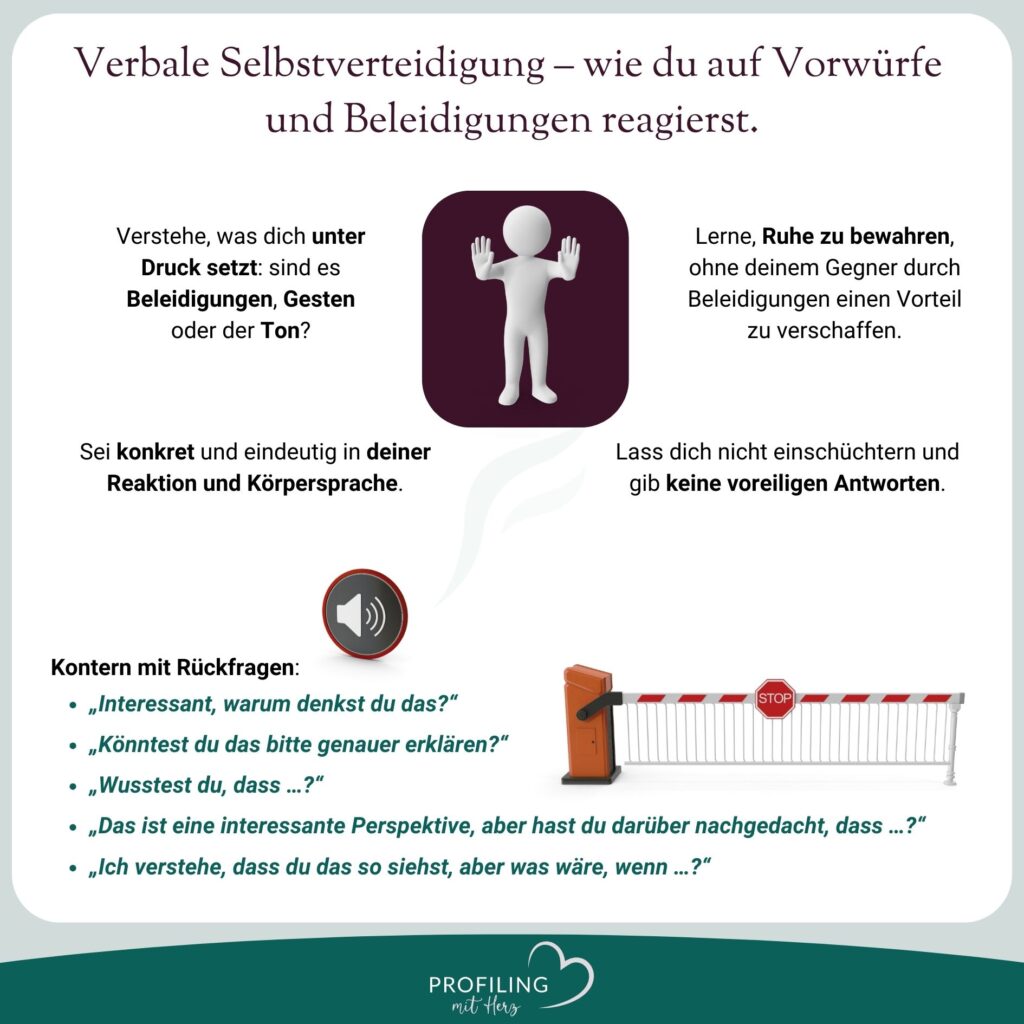
Ask counter-questions:
A proven method is to counter verbal attacks with questions. By asking a question, you can leave the attacker hanging and regain control of the conversation.
reaction speed:
In many situations, you only have a brief reaction time of three precious seconds. After that, the opportunity is irretrievably lost. Unfortunately, it is frequently observed that women tend to..., overthinking and not daring.
Harmonious relationships are very important to them, as they don't want to upset anyone or appear difficult. Women immediately consider the potential consequences of their actions. Upbringing, socialization, and the expectations of others play a crucial role in this. Perhaps a disturbed mother-daughter relationship or are negative beliefs the causes.
Women often blame themselves and dwell too long on critical comments. It's important to gradually move away from negative thought patterns and behaviors. to free.
To be quick-witted, it's important to train your reaction time. Even if you have a lot of knowledge in your head, that doesn't automatically mean you can respond quickly. Often, the problem lies in accessing that knowledge.
Many people struggle to recall their knowledge at the crucial moment. Therefore, it is essential to regularly review and memorize the answers in order to use them when needed. to have ready.
But verbal self-defense goes beyond simply warding off attacks. It is also a way to gain respect and recognition in the communication to foster positive relationships with others. By treating the words and feelings of others with respect, we can contribute to creating a climate of mutual respect and understanding.

In this blog post, we've taken an in-depth look at verbal self-defense. Insults and accusations can hurt us and throw us off balance, but there are ways to stand up for ourselves.
It's important to recognize verbal attacks. Pay attention to your emotions, as they are your early warning system. Techniques Asking questions or redirecting the attack can help you defend yourself.
You have the right to defend yourself against verbal attacks. Women often tend to prioritize harmony over conflict, and to avoid confrontations, but it is important that they maintain their dignity and do not let themselves be defeated by insults or unjustified accusations.
Instead, we want to encourage you to actively stand up for yourself. Whether by learning verbal self-defense techniques, obtaining information, or... professional support or simply by standing up for yourself in difficult situations – every step you take towards Strengthening your resilience Taking this step is a step in the right direction. It also strengthens your self-efficacy.
Don't forget that being quick-witted isn't an innate talent, but a skill that can be learned and practiced. With patience, practice, and a willingness to face challenges, you can learn to respond confidently to accusations and insults and enhance your self-confidence. Strengthening self-confidence.
Your Julia & your Steffen
Disclaimer: This text is for informational purposes only. If you are experiencing trauma, please seek advice from an expert (e.g., a therapist, counselor, or other professional). Therapists).
All images and 3D elements used in this post are from Envato Elements and are used under a valid license.
Keywords: Dealing with insults and verbal attacks, becoming quick-witted, verbal self-defense, letting verbal attacks fall flat, quick-witted replies, women appearing confident, insults in relationships, responding with wit.
Sources / Links (without Wikipedia)
BMFSFJ. (2023, July 11). Recognizing forms of violence. BMFSFJ. https://www.bmfsfj.de/bmfsfj/themen/gleichstellung/frauen-vor-freude-schuetzen/haeusliche-violent/ Formen-der-violent-erkennen-80642
DER SPIEGEL. (2017, April 25). The five nastiest attacks – and how to counter them. DER SPIEGEL. https://www.spiegel.de/karriere/rhetorik-wie-man-sich-gegen-unfaire-angriffe-wehrt-a-1143052.html
Deutschlandfunk Nova. (2023, December 1). Women are the main target of online hate. Deutschlandfunk Nova. https://www.deutschlandfunknova.de/beitrag/hate-speech-frauen-hauptziel-von-hass-im-netz
Fischer, C. (2019, October 23). Workplace discrimination: What can women do?. Badische Neueste Nachrichten. https://bnn.de/karlsruhe/diskriminierung-am-arbeitsplatz-was-koennen-frauen-tun
FRA Europe. (2014). Violence against women – European Union Agency for Fundamental Rights. FRA Europe. https://fra.europa.eu/sites/default/files/fra-2014-vaw-survey-at-a-glance-oct14_de.pdf
Gleiser, C. (2013, August 29). Verbal self-defense. Cla.Gleiser.Understandable. https://verstaendlich.ch/2013/08/29/verbale-selbstverteidigung/
Gustav. (2022, July 30). Learn to be quick-witted: techniques, examples and 6 exercises. Learning Communication. https://kommunikation-lernen.de/schlagfertigkeit-lernen/
Heidenberger, B. (2023, January 15). Quick wit → 10 tips, exercises & 3 techniques for becoming quick-witted (becoming quick-witted). TIME BLOSSOMS. https://www.zeitblueten.com/news/schlagfertigkeit/
Hesener, B. (2024, January 5). 5 tips on how to counter verbal attacks like a pro. impulses. https://www.impulse.de/selbstmanagement/verbale-attacke-wehren/7306047.html
Melanie. (2022, September 12). How to react to verbal attacks – 7 effective strategies. honey pearls. https://honigperlen.at/2022/09/reagiere-so-wenn-dich-jemand-kraenkt-oder-angreift-7-selbstschutz-tipps/
Statista Research Department (Study by the Institute for Applied Sexual Science and Merseburg University of Applied Sciences). (2021, February). Experiences of sexual harassment by gender in 2020. Statista Research Department (study by the Institute for Applied Sexual Science and Merseburg University of Applied Sciences). https://de.statista.com/statistik/daten/studie/1254543/umfrage/erlebte-formen-sexueller-belaestigung-nach-geschlecht/
Tatter, E. (2023, October 18). Psychology: The 11 most important facts about overthinking. ELLE. https://www.elle.de/lifestyle-psychologie-die-11-mehrsten-fakten-zu-overthinking

Mental & Mindset Coaching

Personality & Career Profiler

Want to relieve inner tension? Reduce emotional and subconscious stress with anti-stress gifts for women!

Overbearing behavior in a partnership – How to talk about it, set boundaries, and when a separation makes sense.

25 questions and 18 impulses for self-discovery: How to regain more confidence in yourself!
TAKE ADVANTAGE OF OUR FREE TIPS AND INSPIRATION!
THEN PLEASE SUBSCRIBE TO OUR NEWSLETTER

E-book
„"THE POWER OF CHANGE"“

The free e-book "The Power of Change: 5 Strategies to Successfully Replace Negative Habits" is a valuable tool that will help you identify negative habits and replace them with positive behavior.