

Authors: Julia Blömer & Dr. Steffen Blömer
Published on:
Updated on:
Short version:
If you need support, please feel free to sign up for a free initial consultation on. Or just look in our shop, to see if there's something suitable for you.
Be the change you wish to see in the world – start with our exclusive mini-challenge. Discover how you can positively change your environment and your life by showing more empathy. Register today and download the mini-workbook!
Imagine you're in an important meeting. The atmosphere is very serious. Suddenly, your boss completely misunderstands something you said. Instead of asking for clarification, he immediately becomes angry.
You feel unfairly treated, and afterwards your mood is at rock bottom. If your boss had been understanding, he could have avoided this problem.
What happens when empathy is lacking? People feel unheard, misunderstood, and in the worst case, rejected.
It is crucial that we can understand how other people feel. If we cannot, conflict arises, as the previous example shows. Empathy is perhaps the key. most important characteristic of our time, to lead a successful and harmonious life.
It's about acknowledging the perspective of other people and to respect, even if it differs from yours. A lack of this ability leads to conflicts and misunderstandings.
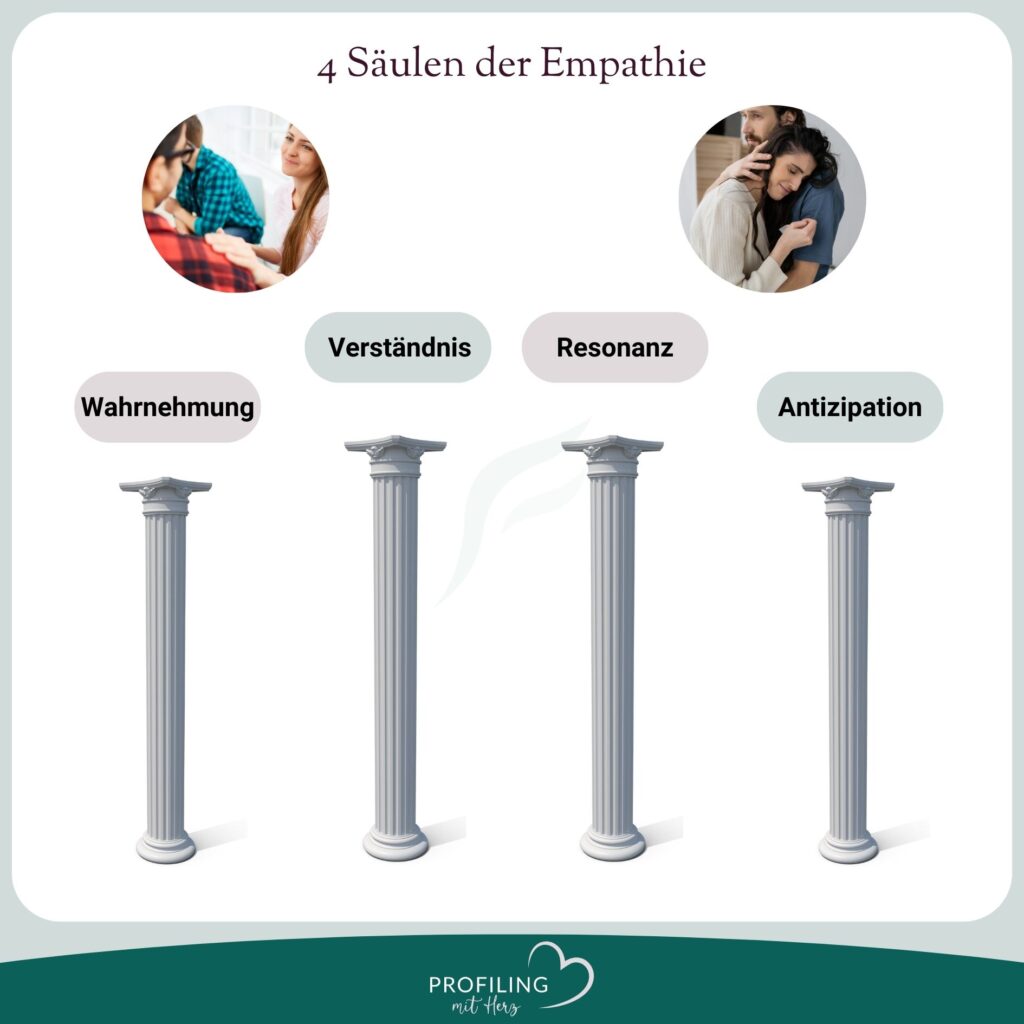
The solution? The four pillars of empathy:
Perception, understanding, resonance, and anticipation.
These pillars offer a signpost, how we can use understanding and compassion in our everyday lives.
Using these concepts will help you resolve conflicts and make everyone feel good. put into the shoes of others, This brings new solutions because you speak openly and respectfully.
„"If we could read the secret history of our enemies, we would find in every life enough sorrow and suffering to disarm all hostility." Henry Wadsworth Longfellow
Let's embark on this journey together to create an empathetic world.
Definition and meaning
Empathic perception is the key to seeing the world through the eyes of others. It allows us to recognize the nonverbal signals that people send out. These are expressed through their facial expressions, gestures, or body language.
This ability is invaluable, especially in business. Why? Because it helps us better understand what our colleagues, customers, or business partners really mean, even if their words suggest otherwise. This allows us to communicate more effectively, avoid misunderstandings, and build deeper relationships.
Exercises:
To sharpen your perception of nonverbal communication, here are some practical tips:
By learning to interpret the nonverbal signals of others, you open the door to deeper connections. This is not only valuable in your personal life, but also a crucial factor for success in the business world.
Understanding goes far beyond simply listening. It is a deeper immersion into the other person's world of thought. An empathy that allows us to truly grasp what lies behind the words.
Active listening
The key is to listen actively. This means being present when someone is speaking. You don't just listen with your ears, but with your whole being. You signal to the other person that you are interested, without immediately judging.
Exercises:
To improve your active listening skills, try the following practical tips:
These techniques will help you develop a better understanding of your environment and to grow personally. They also foster a climate of trust and openness. In such an environment, relationships and innovations flourish.
Definition and meaning
Emotional resonance – it almost sounds like music. And indeed, it's about a harmonious interplay, a deep understanding, and a shared sense of empathy. When we resonate emotionally with someone, our feelings are on the same wavelength. This creates a strong connection and is a foundation for lasting relationships.
How do we achieve this resonance? It begins with genuine interest and the desire to see the world through the eyes of another. resonance It is a type of relationship that goes beyond mere understanding. It is an empathy that allows us to experience the other person's emotions as if they were our own.
A good example of emotional resonance can be found in the Partnership work. Nadja Polzin emphasizes the importance of engaging with one's partner's concerns and offering space for their feelings and thoughts. This kind of emotional connection works wonders by creating closeness and defusing conflicts.
Tips:
By learning to resonate emotionally with others, we open doors to fulfilling relationships. We build bridges of understanding and empathy. This enriches not only our personal happiness but also that of those around us. In this way, the world becomes a brighter and warmer, little by little.
Imagine you could predict other people's thoughts and feelings. What would that be like? your relationships – privately and professionally – how can we improve? This is precisely where the last building block of the four pillars of empathy comes into play.
Anticipation means foreseeing the needs and emotions of the person you're interacting with and acting accordingly. This shows that you are willing to go the extra mile to help others.
Why is anticipation important?
Acting proactively shows that you care about the well-being of others. In the workplace, this could mean, for example, recognizing a colleague's workload and offering help.
Or you, if a friend needs support, and you provide it to them without them having to ask for it.
Strategies for proactive action:
The ability to anticipate makes us better partners, friends, and colleagues. It forms the basis for a supportive and caring environment where everyone feels understood and valued.

Empathy is a bridge that connects us to the hearts of others. But building this bridge can be challenging. Obstacles such as misunderstandings, prejudices, and our own emotional state can make it difficult.
One misconception is confusing empathetic behavior with unconditional compliance. Genuine empathy It means understanding the other person's perspective without overstepping one's own boundaries.
It is often difficult to understand how people feel who have had different experiences than we have. Developing empathy is a process that involves recognizing and overcoming our own prejudices.
Learning from mistakes
There will be setbacks along the way. Perhaps. Are you misinterpreting this? Whether you're experiencing the emotions of a friend or feeling overwhelmed in a situation, it's important to see these moments as learning opportunities.
Every mistake allows you to sharpen your empathic skills and develop an understanding of emotions.
With every obstacle you overcome and every mistake you make, you can better empathize with others.
Disadvantages of empathy?
However, there are also some Disadvantages Empathy can have negative consequences, such as increased susceptibility to manipulation. With too much empathy, one "suffers along with others." Those who are highly empathetic often don't prioritize their own needs.
Therefore, it is important that we, as empathetic people, know our emotional boundaries and protect ourselves.
Empathy crystallizes in three main forms Outcome: emotional, cognitive, and social empathy.
Highly empathetic people They are characterized by a balanced mix of these three forms of empathy. They have a keen sense for the emotions of others and understand their thought processes.
They are adept at navigating social situations. Often, they are people who have themselves accumulated diverse life experiences. These individuals have learned to develop a strong sense of empathy from these experiences.
It is their ability to think outside the box and to establish a deep connection to the experiences of others.
Empathetic people are good listeners who patiently and without prejudice listen to the stories of others. They recognize that beneath the surface of every story lie similar longings, fears, and joys.
Empathy is the invisible bond that holds humanity together. In our search for a more harmonious society, the four pillars of empathy play a key role.
They allow us to look beyond our horizon of experience and to communicate on equal terms.
We encourage you to do at least one exercise to strengthen your empathic skills in the coming week.
Perhaps you could start by listening attentively without immediately criticizing. Or you could imagine how the other person might experience a situation.
What would our world look like if everyone applied the four pillars of empathy?
Discover in our guide Further practical tips and strategies to improve your empathy skills and apply them in everyday life.
Your Julia & your Steffen
Disclaimer: This text is for informational purposes only. If you are experiencing trauma, please seek advice from an expert (e.g., a therapist, counselor, or other professional). Therapists).
All images and 3D elements used in this post are from Envato Elements and are used under a valid license.
Keywords: 4 pillars of empathy, conflict resolution, example of empathy, social empathy, active listening, emotional empathy, cognitive empathy, dealing with other people, empathy relationship, empathic people.
Sources / Links (without Wikipedia)
Career strategy. (nd). Gestures and facial expressions. Career strategy. https://www.berufsstrategie.de/bewerbung-karriere-soft-skills/gestik-mimik.php
Applications.de. (2022, February 24). Empathy as a competence. Bewerbungen.de. https://www.bewerbungen.de/bewerbung/kompetenzen/empathie-als-kompetenz/
Boll, K. (2020, May 7). Feedback among colleagues – these proven tips for a positive feedback culture. PINKTUM. https://www.pinktum.com/de/blog/feedback-unter-kollegen-mit-diesen-bewaehrungen-tipps-gelingt-es-guaranteed/
Cullen, E. (n.d.). How to ask open-ended questions: 20 examples. Mentimeter. https://www.mentimeter.com/de-DE/blog/stand-out-get-ahead/how-to-create-open-ended-questions
Eberwein, W. (2016, October 15). What is resonance?. Werner Eberwein. https://werner-eberwein.de/was-ist-resonanz/
World of Thoughts. (2022, February 12). Empathy: Putting yourself in someone else's shoes. Thought World. https://gedankenwelt.de/empathie-dich-in-jemanden-hineinversetzen/
Giesbrecht, A. (2023, June 7). Personality development and empathy: Do trainers need to be empathetic?. Instructor's Certificate 24. https://ausbilderschein24.de/persoenlichkeitsentwicklung-und-empathie/
Goldstein, Ph. DE (2022, March 1). People are watching. wikiHow. https://de.wikihow.com/menschen-beobachten
Greator. (2023, June 19). Empathy: Perhaps the most important quality of our time. Greator. https://greator.com/empathy-important-feature/
GU. (2023, July 18). This is how you can find peace in everyday life!. GU. https://www.gu.de/achtszeit-ruhe-alltag/
IGEMO. (2020, November 22). Reflective ability – Empathy – Mindfulness. IGEMO. https://www.igemo.at/reflexionsfaehigkeit-empathie-mindfulness/
Komar, L. (2018, November 6). What is meant by personality development?. teamazing. https://www.teamazing.de/was-verscht-man-unter-persoenlichkeitsentwicklung/
Lotz, M. (2022, July 27). Mindfulness in everyday life – letting go of judgments: Interpreting makes you unhappy.. evidero. https://www.evidero.de/macht-unserer-denken
Luerweg, F. (2022, August 10). empathy. Psychology Today. https://www.psychologie-heute.de/leben/artikel-detailansicht/42084-empathie.html#toc-arten-der-empathie
Luise. (2020, April 7). Genuine empathy beyond societal norms: A deep look at the art of understanding. zeitgeistich. https://www.zeitgeistich.de/echte-empathie/
Mai, S. (2022, July 6). Empathy: Definition, opposite, advantages & disadvantages. Herbstlust. https://herbstlust.de/empathie/
Marzullo, S. (2016, August 11). 15 skills that define empathetic people. IME. https://www.ime-seminare.de/blog/15-faehigkeiten-empathe-menschen/
Polzin, N. (2022, January 31). What exactly is resonance in relationships?. Nadia Polzin. https://www.nadjapolzin.com/resonanz-in-relations/
Sevindik, N. (2021, May 17). Exercises to learn to express feelings. Live in Harmony. https://www.lebe-in-harmony.com/emotionen-ausdruecken-lernen/
StudySmarter. (nd). empathy. StudySmarter. https://www.studysmarter.de/schule/psychologie/basisndisciplines-der-psychologie/empathie/
thinkwithyourheart. (2021, November 12). Being present – what does that actually mean?. thinkwithyourheart. https://www.thinkwithyourheart.site/post/praesent-sein-was-meant-das-actually
Willeke, S. (2022, December 1). Tips for a happy relationship: What keeps couples together. Sarah Willeke. https://www.psychologin-willeke.de/tipps-fuer-eine-glueckliche-relation-was-familien-einanderhaelt

Mental & Mindset Coaching

Personality & Career Profiler

Want to relieve inner tension? Reduce emotional and subconscious stress with anti-stress gifts for women!

Overbearing behavior in a partnership – How to talk about it, set boundaries, and when a separation makes sense.

25 questions and 18 impulses for self-discovery: How to regain more confidence in yourself!
Be the change you wish to see in the world – start with our exclusive mini-challenge. Discover how you can positively change your surroundings and your own life with more empathy.
Sign up for the newsletter today and download the mini-workbook!
TAKE ADVANTAGE OF OUR FREE TIPS AND INSPIRATION!
THEN PLEASE SUBSCRIBE TO OUR NEWSLETTER

E-book
„"THE POWER OF CHANGE"“

The free e-book "The Power of Change: 5 Strategies to Successfully Replace Negative Habits" is a valuable tool that will help you identify negative habits and replace them with positive behavior.