

Authors: Julia Blömer & Dr. Steffen Blömer
Published on:
Updated on:
Short version:
How to effectively respond to overbearing behavior in a partnership:
Setting boundaries and asserting oneself:
If you need support, please feel free to sign up for a free initial consultation on. Or just look in our shop, to see if there's something suitable for you.
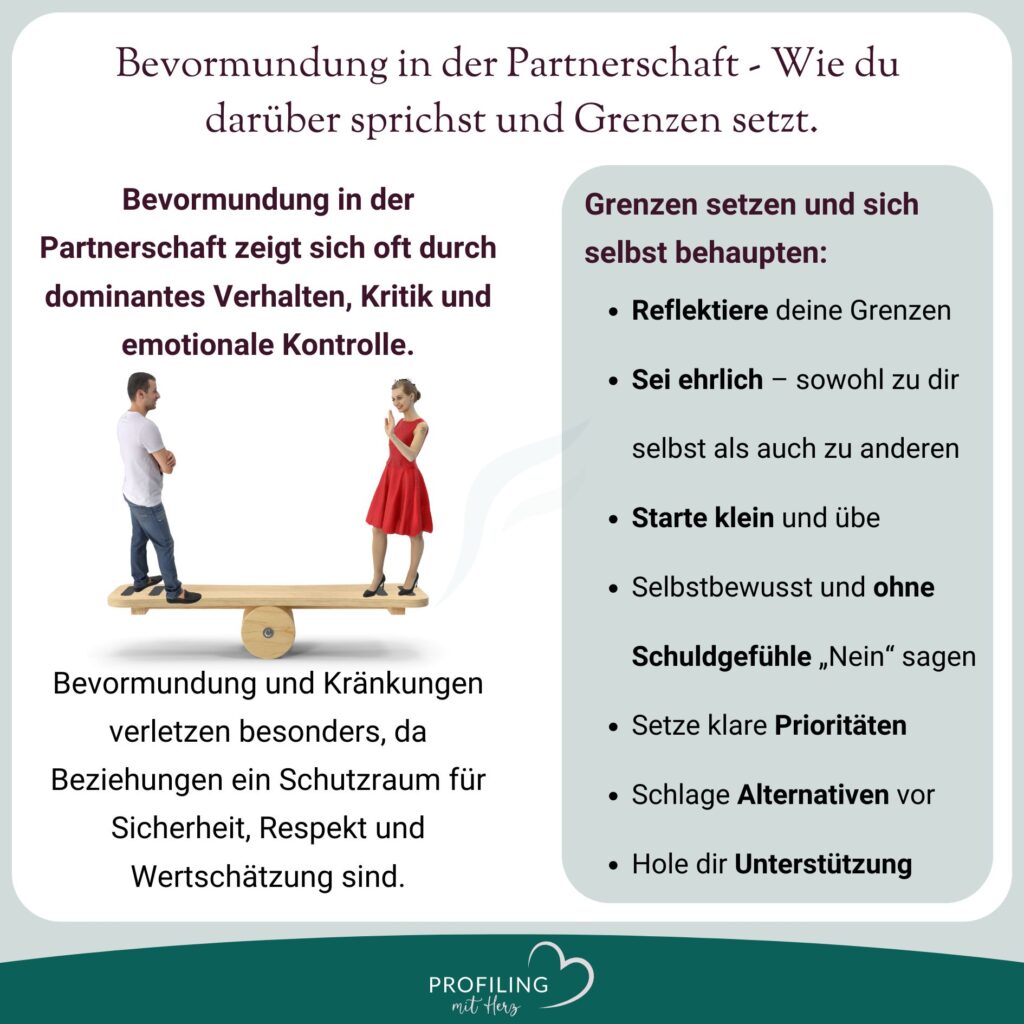
You're at a party, and your partner interrupts you mid-sentence to "correct" your story. He smiles charmingly at everyone as he explains that you were mistaken. He continues the story in his own way. What seems like a harmless joke to others hits you like a ton of bricks.
A dominant partner who belittles your opinion or treats you disrespectfully leaves deep wounds in your relationship. When words eventually become insulting, you will eventually feel powerless and worthless.
Results of a study
One ElitePartner investigation According to the survey, 71% of women and 59% of men find patronizing and lecturing statements hurtful.
Women also feel hurt by derogatory comments from their partner about their appearance or clothing. Approximately two-thirds of the female respondents stated that such remarks particularly hurt them (66 %).
The path to greater strength
But you can break out of this cycle. Learn to set boundaries to create clarity and respect. Strengthen your inner voice by taking your needs seriously and standing up for them.
It takes courage, and you have to work on fighting for yourself with strength and confidence. A relationship should support you, not destroy you. clear communication With self-respect, you can regain control and create a loving, appreciative relationship.
Overbearing behavior in a partnership can creep up on you, often unnoticed – until it leaves deep wounds in the relationship. A dominant partner makes decisions over your head, without involving you.
Sentences like „I know what's best for you.“" or "„That's how we'll do it now!“They sound harmless at first, but they are clear warnings to you.
Demeanors and rejections
A partner who treats you disrespectfully regularly criticizes your decisions, your appearance, or your goals. Such remarks make you feel inadequate, which severely damages your self-confidence.
You constantly feel pressured and justify yourself over every little thing. Or you try to avoid conflict at all costs so as not to make the situation worse.
Manipulation in the relationship
This manifests itself subtly, for example through emotional control, blaming, or small threats. These behaviors They can manifest as passive-aggressive comments and ignoring the partner's needs, or as the deliberate exploitation of weaknesses.
Security within the protected space of the relationship
A relationship should be a place of safety. A place where you feel understood, valued, and respected. If this safe space is destroyed by overbearing or disrespectful behavior, often only insecurity remains.
Statements such as „I know better than you!“Or disparaging remarks can act like sharp blades that cut through your trust.”.
Deep wounds caused by emotional closeness
The closeness in a partnership makes you particularly vulnerable. It's as if you're giving someone the key to your innermost self – only to discover that your partner shows you no appreciation whatsoever.
When your autonomy is disregarded and insults dominate your daily life, the foundation of your relationship crumbles. Such deep emotional wounds can linger for a long time.
Reflection questions:
Differences make a relationship exciting and vibrant. Diverse hobbies, interests, and opinions contribute to making the relationship multifaceted and strong. At the same time, personal space is essential. Maintaining your independence not only strengthens you but also fosters the relationship. Balance in your relationship.
Autonomy gives you strength and makes you self-confident. Setting boundaries in your relationship helps avoid being patronized. Different opinions don't have to be a point of contention. They are an opportunity to learn from each other and build trust.
A balance of closeness and personal growth is key to a strong partnership. You can develop and love without only having to make compromises.
Setting boundaries It can save a relationship – not because it creates distance, but because it promotes mutual respect.
Types of border crossings
When faced with emotional control, such as through manipulation or blaming, you should react clearly and directly. Use "I" statements, like "„I want you to respect my decisions!“, to clarify your position.
In case of disrespectful behavior, When faced with hurtful or derogatory remarks, for example, it's important to act immediately. It helps to address the statement right away and make it clear that you won't tolerate being treated that way.
Tips for setting effective boundaries:
Feel free to use our 4-week plan – Learn to set loving boundaries.
Get support
To say "no" without feeling guilty It can be challenging, especially at the beginning. Reach out to friends, family, or experts if you need help or advice. Feel free to book a free initial consultation with us.
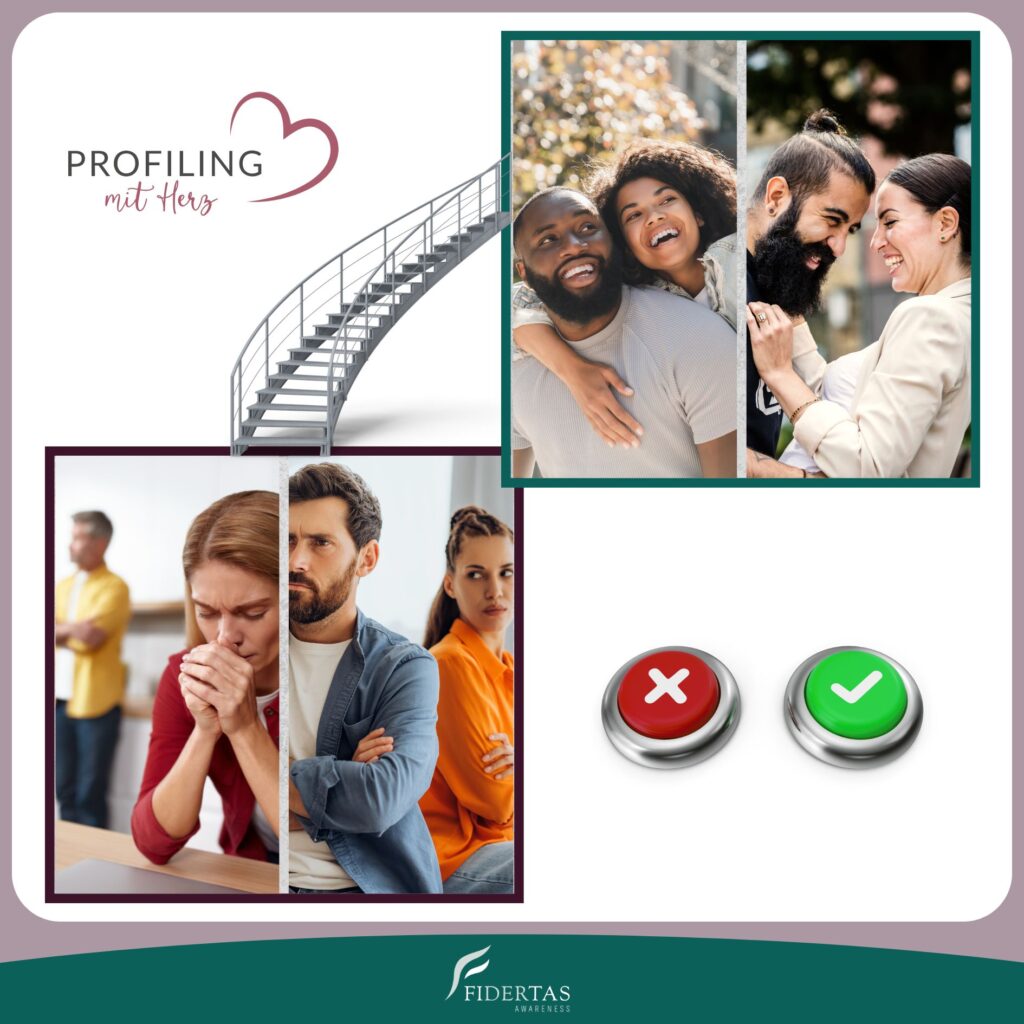
A relationship should support you without restricting you. Constant manipulation makes you feel trapped in a spiderweb of control and mistrust.
A dominant partner will monitor you, make decisions for you, and gradually erode your freedom. If your partner remains disrespectful and insulting, it will erode your self-esteem.
Finding the courage to change
Even though it's difficult, a separation can be the step that gives you back peace and strength. If your partner is constantly controlling and shows no understanding, then it's probably the right thing to do. a toxic relationship. Proactively step out of this dynamic, and let people go.
A future with respect
Relationships need to be on equal footing.. Look for a partner who doesn't want to control you, but supports you. Someone who takes your needs seriously and treats you with love.
With this freedom, you can build a life where appreciation comes first. Your well-being matters – now and always!
Every type of relationship thrives on respect and appreciation. Paternalism, Manipulation, disrespect, and insults destroy trust and harmony.
You can't accept things like that. You have the right to clearly communicate your needs and set boundaries. Only then can a relationship based on equality develop.
And if all attempts fail, bravely choose your happiness.
Question for you
What boundaries are important to you in a relationship, and how do you envision a respectful coexistence?
Your Julia & your Steffen
Disclaimer: This text is for informational purposes only. If you are experiencing trauma, please seek advice from an expert (e.g., a therapist, counselor, or other professional). Therapists).
All images and 3D elements used in this post are from Envato Elements and are used under a valid license.
KeywordsSetting boundaries in a relationship, being patronized in a partnership, manipulation in a relationship, self-confident woman, partner is disrespectful and insulting, learning to set boundaries, becoming self-confident course, disrespect in the relationship, powerlessness, courageous, strong and self-confident, dominant partner, deep hurt in a relationship, partner patronizes me.
Sources / Links (without Wikipedia)
Bartsch, B. (2022, December 6). This behavior is the most hurtful in relationships.. ElitePartner. https://www.elitepartner.de/studien/verletzendes-verhalten-in-beziehungen/
Bloom, C. (2024, March 23). Setting boundaries: How to learn to draw boundaries. Chris Bloom. https://chrisbloom.de/blog/border-setting/
Hochheimer, B. (2019, August 12). Disrespect in the relationship – what to do?. www.brittahochheimer.de. https://www.brittahochheimer.de/blog/respektlosigkeit-in-der-beziehung-was-tun/
Hoepker, Dr. J. (2021, September 7). I-messages – The #1 rule for good communication. HabitGym. https://www.habitgym.de/ich-nachrichten/
IKK classic. (2023, October 13). Gaslighting in relationships: Recognizing emotional manipulation. IKK classic. https://www.ikk-classic.de/gesund-machen/leben/gaslighting-relations-erkennen
PartnerWerk (nd). Emotional autonomy in couple relationships. PartnerWork. https://partnerwerk.de/wie-sie-ihrem-partner-gegenueber-gesunde- Grenz-zieh-koennen/
Red Flags: “That’s not what I meant” – These warning signs point to the end of your relationship.. https://www.sixx.de. (2023, September 14). https://www.sixx.de/themen/lust-liebe/news/red-flags-es-war-ja-nicht-so-gemeint-diese-warnzeichen-deuten-auf-das-ende-eurer-relation-hin-72668
Rüttiger, M.-T. (2024, December 19). Setting Boundaries: A Guide to Greater Well-being. ottonova. https://www.ottonova.de/gesund-leben/mentales-training/borne-limits

Mental & Mindset Coaching

Personality & Career Profiler

Want to relieve inner tension? Reduce emotional and subconscious stress with anti-stress gifts for women!
Overbearing behavior in a partnership – How to talk about it, set boundaries, and when a separation makes sense.

25 questions and 18 impulses for self-discovery: How to regain more confidence in yourself!
TAKE ADVANTAGE OF OUR FREE TIPS AND INSPIRATION!
THEN PLEASE SUBSCRIBE TO OUR NEWSLETTER

E-book
„"THE POWER OF CHANGE"“

The free e-book "The Power of Change: 5 Strategies to Successfully Replace Negative Habits" is a valuable tool that will help you identify negative habits and replace them with positive behavior.