

Authors: Julia Blömer & Dr. Steffen Blömer
Published on:
Updated on:
Short version:
We can find out what's important to us by asking simple questions:
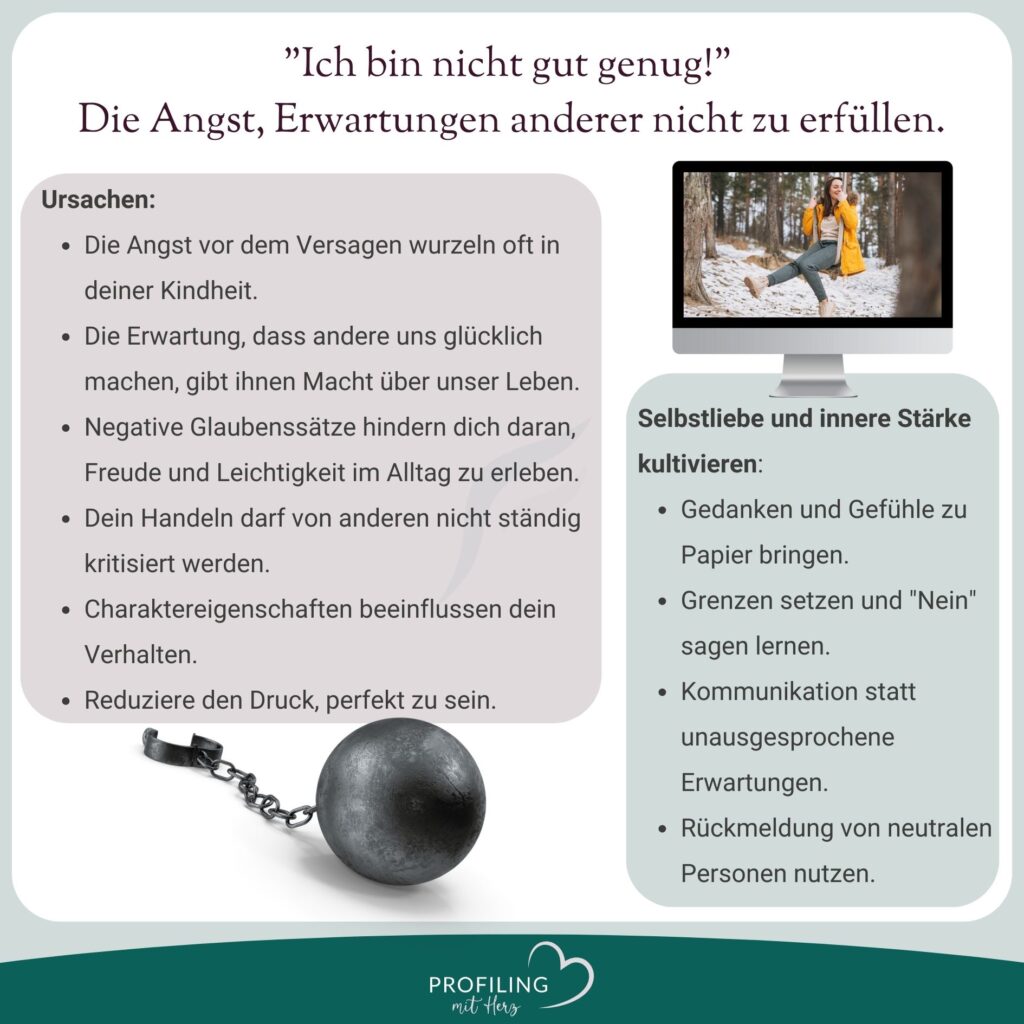
Cultivate self-love and inner strength:
If you need support, please feel free to sign up for a free initial consultation on. Or just look in our shop, to see if there's something suitable for you.
But what if we told you there is a way out of this? emotional prison of dissatisfaction to break out?
The secret lies in finding a balance between fulfilling expectations and maintaining one's own well-being. It is a balancing act, which can be learned and which we will decipher together.
Self-liberation in small steps
To bridge the gap between External expectations To master self-care, you must learn to put yourself first. This doesn't mean neglecting others, but rather finding a healthy balance – without... Feelings of guilt.
„"You won't find your self-worth in the opinions of others."“ - Unknown
Let's explore together how you can transform this pressure into freedom. How you can learn to prioritize while remaining sensitive to the needs of those around you. It's an exciting path that requires courage, but ultimately leads to true joy in life.
Why do we feel so much pressure to always perform? If we look deeper, we discover the roots in societal pressure and the power of social media.
Images of perfect lives flood our screens daily, making our achievements seem insignificant. These constant comparisons are poison for our self-image. We live in constant fear of not meeting expectations and not achieving our goals. „"social reward"“ to obtain.
The attempt to please everyone – what are the underlying reasons for this?
Fear of failure is a powerful driving force behind our constant urge to shine. This fear is deeply rooted within us and erodes our self-confidence. We are then often insecure and have self-doubt.
Often it all starts in childhood: One negative experience and the belief is already formed. „"I'm not good enough!"“ a.
This phrase accompanies us and colors our decisions and actions. Our parents and relatives shape us, and these influences even affect our later expectations of a partner.
An important aspect is Fundamental mistrust. Basic trust develops in the first years of life and forms the foundation for psychological stability and emotional well-being.
The formative experiences of this time leave a lasting mark. Without maternal love, mistrust and low self-esteem can develop.
The solution to this question is challenging and multifaceted. Our society values conformity and Success, which may seem positive on the surface. But this constant pressure to function and the comparison with others, pulls us into a vicious cycle of fear, avoidance and withdrawal.
My partner has to make me happy.
We constantly seek external validation and recognition, instead to give them to ourselves. No one can fulfill our happiness or make us perfect. That is solely our own responsibility. If we rely on others to be happy, we automatically give them power over our lives.
Ask yourself:
Life isn't about conforming and fulfilling the expectations of others. It's about authenticity and forging your own path. Negative beliefs They exert an invisible influence on us. They prevent us from experiencing joy and ease in everyday life. A difficult mother-daughter relationship can create belief systems.
Self-acceptance and the understanding that perfectionism and the fear of rejection only hold us back are first steps. Learning to see our worth independently of external validation opens up new paths to greater fulfillment. Energy and zest for life.
It takes time to... to calm the inner critic and to acknowledge our abilities. It is important to question our critical thinking and recognize that we achieve more than we admit.
Here are some questions to help you delve deeper into the topic and identify possible solutions:
Many believe that what benefits them will also benefit others. Whether it's sports, social engagement, structure, security, etc. – everyone has different expressions of their life motives. It's not necessary for everyone to have the same thing. Advice to follow blindly.
Your Life motives They provide information about what is important to you and what what drives you. Just because your father loves exercise doesn't mean you have to. And just because your mother never compromises her principles doesn't mean you have to either.
Freedom vs. Security:
Community vs. Independence:
Tradition vs. Innovation:
All behavior is not inherently "good" or "bad," but rather an expression of life's motivations. We must understand that everyone has their own. own inner motivation has. And respect it if someone decides differently than we would. That way we can Interact more empathetically.
The opinions of others do not automatically constitute our "obligation" to behave in a certain way. You don't have to please everyone.!
Your Character traits They determine how you behave. Often we aren't aware of this. Every person has "opposing" poles within them. The stronger we tend towards one side of these facets, the more extreme our behavior will be in similar situations.
Performance orientation vs. interest orientation
1a) Performance orientation: Example Anna
Anna, A successful marketing manager at an advertising agency, she often works overtime. She works weekends to gain recognition and exceed expectations.
This brings her promotions and bonuses, but costs her her health, social contacts and personal interests.
Their example shows that an excessive focus on performance and the fear of failure can have negative consequences.
1b) Interest orientation: Example Lisa
Lisa She is a graphic designer at a young company and was drawn to this job because of her passion for creativity. Her love for her work motivates her more than the pursuit of specific achievements.
However, in a competitive environment, she finds it difficult to assert herself. She takes criticism personally and fears being seen as inadequate because her work does not meet the strict performance standards.
A strong passion in a performance-oriented world can lead to self-doubt when personal preferences and professional expectations clash.
Stress perception vs. stress resilience
2a) Experiencing stress: Example Lena
Lena, a dedicated project manager, lives under high pressure, which she cannot shake off even in her free time.
Instead of relaxing, she constantly tries to be productive. She wants to live up to the expectations of others, whether in sports, social activities, or reading. Her choice of activities is based more on pleasing others than on her own enjoyment.
This inability to switch off leads to constant stress – she is overwhelmed and exhausted.
2b) Stress resistance: Example Sarah
Sarah, a software developer with high stress resistance, confidently handles professional challenges, but paradoxically finds no relaxation in her free time.
Her inability to recognize the need for breaks leads her to fill her free time with additional projects. Genuine periods of rest are rare.
Despite her resilience to stress, she shows signs of fatigue in the long run. She doesn't allow her body and mind any rest in order to exceed her own expectations.
Humility vs. Positive Self-Presentation
3a) Modesty: Example Katharina
Katharina She is a modest woman who puts her needs and desires aside for those of her partner. She rarely suggests activities of her own or talks about her wishes. She believes that true modesty lies in complete self-restraint.
Katharina's constant reticence makes it difficult for her partner to understand her and recognize her needs. This leads, in the long run, to both partners becoming frustrated and... lonely are.
3b) Positive self-presentation: Example Melanie
Melanie She places great importance on portraying their relationship on social media in order to always present a perfect image. This fixation manifests itself in a loss of high-quality time together.
Melanie's portrayal puts her partner under pressure to constantly meet expectations on social media. This focus on public image prevents an authentic partnership.
Our expectations of our environment, our relationships, and ourselves can sometimes overwhelm us. We want everything to be perfect and are dissatisfied when things don't go as planned.
We often put ourselves and our partners or fellow human beings under unnecessary pressure. By making our expectations more realistic, we relieve ourselves and strengthen our relationships. It's not about wanting less, but about letting go of expectations.
Perfectionism is often linked to fear of failure. Many people strive for perfection because they fear that mistakes or unachieved goals could reflect negatively on them.
The pursuit of perfection makes us unhappy. Once we realize this, we can we are taking countermeasures. We learn what counts: less perfect results, more real moments!
By asking simple questions, we discover what's important to us. We differentiate between "must" and "can," between pressure and joy. In this way, we focus on what fulfills us and let go of expectations.
These reflection questions will help you examine your perfectionism from different perspectives and reveal ways to free yourself from the expectations placed on yourself and others. They will help you let go of your perfectionism in certain situations.

Constantly trying to live up to other people's expectations can be exhausting. It's time to let go of that pressure and focus more on yourself. Here are some steps you can take. self-love and Self-care You cultivate and develop your inner strength.
A to keep a diary, This helps you bring order to your thoughts and feelings. Write down three things you are grateful for each day, and also your three successes of the day.
Additional questions, if you wish:
Knowing and respecting your personal boundaries makes you stronger. Learn to do so without guilt. „to say "no". Understand what is good for you and do it.
This boosts your self-confidence and helps you let go of others' expectations. healthy selfishness is essential.
Speak openly about your needs and desires. Clear communication It prevents misunderstandings and reduces unnecessary expectations. This way, you actively shape your own fulfilling life and enjoy more joy.
Get feedback from people you trust. Or use "neutral perspectives" from external experts. New perspectives provide valuable insights and show that the fear of not being good enough is often unfounded.
By taking these steps, you build a deeper relationship with yourself. Allow yourself to feel and experience joy, independent of external expectations. The path to self-love It requires patience, but it leads to true happiness and contentment.
On our journey of discovery through self-doubt and the fear of not being good enough, we have learned a lot. We now know ways to free ourselves from the expectations of others.
We have seen how valuable it is to come to terms with ourselves, to set clear boundaries, and to clearly communicate our needs.
Now it's time to bravely follow your own path. You no longer let others define you. Despite Don't give up after setbacks.. Everyone has the right to their own happiness and to define success for themselves. Perfection is not the goal. to be authentic is it!
What first step will you take today to break free from expectations? How will you find your joy in life?
„"When you let go, you have two hands free to grasp something new."“ - Unknown
If you need support, we are here for you. At online coaching Let's find ways together to meet your needs to discover inner strength and letting go of expectations of yourself and others. As certified life coaches, we can use our experience to help you resolve deep-seated emotional blocks.
Your Julia & your Steffen
Disclaimer: This text is for informational purposes only. If you are experiencing trauma, please seek advice from an expert (e.g., a therapist, counselor, or other professional). Therapists).
All images and 3D elements used in this post are from Envato Elements and are used under a valid license.
Keywords: Meeting expectations, fear of not meeting expectations, experiencing joy, dealing with the expectations of others, disappointing expectations, dissolving limiting beliefs, the belief "I am not good enough", developing inner strength.
Sources / Links (without Wikipedia)
Agness, K. (2021, October 4). Expectations of your partner and how they sabotage your happiness. Finally loved! https://www.kristinagnes.com/erwartungen-an-den-partner/
Diane. (2022, February 22). Meeting the expectations of others – 7 steps to mental freedom. Journey of Life. https://www.journey-of-life.de/die-erhalten-anderer-erfuellen-7-stiege-zur-mentalen-freiheit/
Engelfried, L. (2021, February 16). Let go of perfectionism for happy and relaxed creative time in everyday life: Here's how! Creative Academy. https://kreativ-akademie.com/perfektionismus-ablegen/
Funk, S. (2022, November 14). Self-love: 7 tips to learn to love yourself. Joy of Life Academy. https://lebensfreude-academy.de/selbstliebe-7-tipps-dich-selbst-lieben-zu-lernen/
Hielscher, B. (2018, January 14). Being authentic – A short guide. Bettina Hielscher Coaching. https://www.bettinahielscher.de/authentisch-sein/
LINC. (2024, May 30). BIG FIVE PERSONALITY TEST LINC PERSONALITY PROFILER. LINC. https://linc.de/lpp-persoenlichkeitstest-bigfive/
Monday, Prof. Dr. C. (2023, July 7). Bad for the brain? Social media and our children. Konrad Adenauer Foundation e. V. https://www.kas.de/de/web/die-politische-meinung/blog/detail/-/content/schlecht-fuers-gehirn
Schümann, J. (2023, February 24). Breaking free from expectations. Jasmin Schümann Coaching. https://www.jasmin-schuemann.de/aus-erwartungen-ausbrechen/
Seiler, LM (2024, March 18). 7 journaling tips to help you change your life. Laura Seiler Life Coaching. https://lauraseiler.com/7-journaling-tipps-die-dir-dabei-helfer-dein-leben-zu-veraendern/
Sütfeld, C. (nd). External pressure – How to free yourself from expectations. Carol Sue. https://www.carolinsue.com/expectations/
Tempel, K. (2022, February 14). Learn self-care: 8 questions to make you feel good. Happiness Detective. https://www.gluecksdetektiv.de/selbstfuersorge-lernen/

Mental & Mindset Coaching

Personality & Career Profiler

Want to relieve inner tension? Reduce emotional and subconscious stress with anti-stress gifts for women!

Overbearing behavior in a partnership – How to talk about it, set boundaries, and when a separation makes sense.

25 questions and 18 impulses for self-discovery: How to regain more confidence in yourself!
TAKE ADVANTAGE OF OUR FREE TIPS AND INSPIRATION!
THEN PLEASE SUBSCRIBE TO OUR NEWSLETTER

E-book
„"THE POWER OF CHANGE"“

The free e-book "The Power of Change: 5 Strategies to Successfully Replace Negative Habits" is a valuable tool that will help you identify negative habits and replace them with positive behavior.