

Author: Julia Blömer
Published on:
Updated on:
🎤 Listen to the blog post (by "Lena", AI voice):
Short version:
Identifying emotional triggers and causes:
How to resolve emotional triggers:
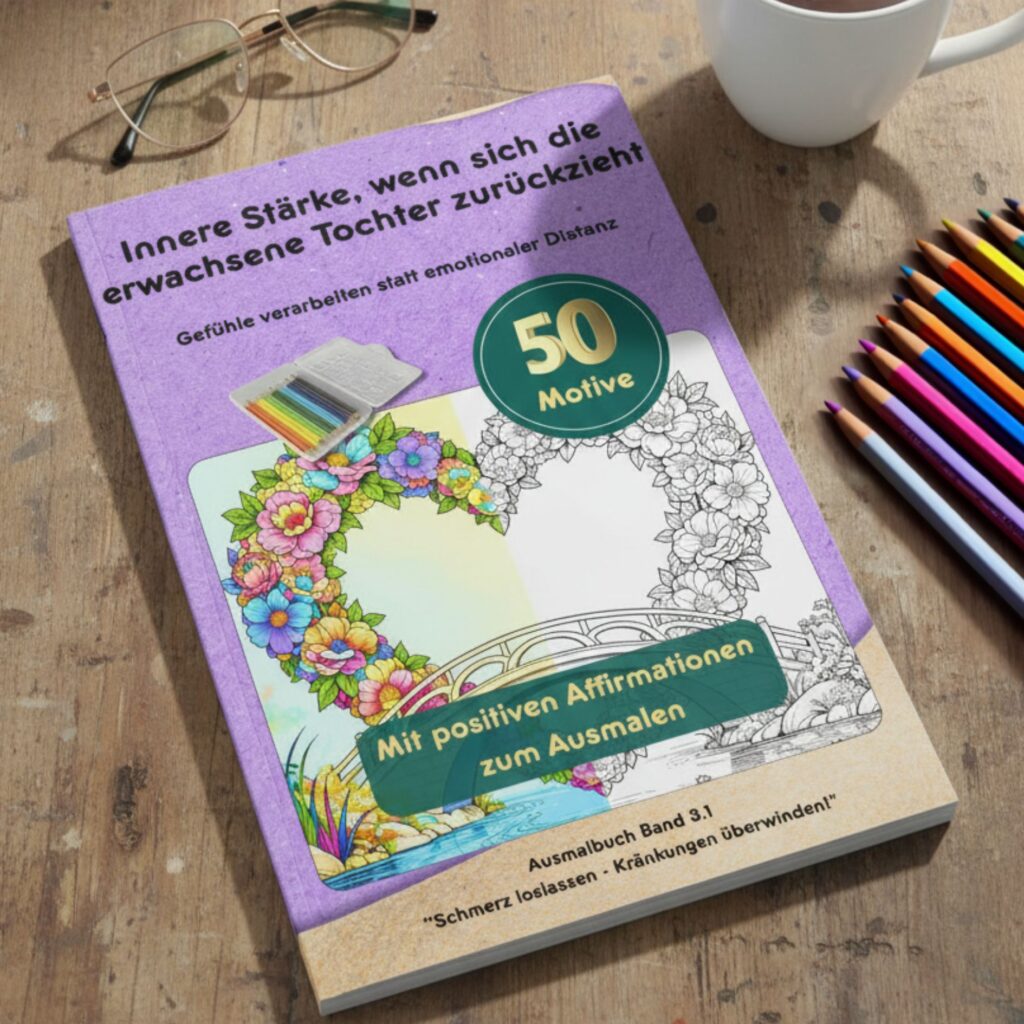
Use this unique coloring book „Inner strength when the adult daughter withdraws: processing feelings instead of emotional distance„"This coloring book accompanies you on your journey to mindfully perceive your feelings and find inner peace. It supports you in staying connected to yourself, even in difficult moments, and in drawing inner strength.".
If you need support, please feel free to sign up for a free initial consultation to.

You sit alone in your living room, the empty space beside you almost tangible. You used to laugh here, talk for hours, and make plans together. But for a long time now, your conversations have been superficial, like small talk.
Your adult daughter is withdrawing more and more, and you feel an invisible wall growing between you. You might be wondering:
The gap is widening.
Perhaps you now avoid certain topics of conversation because they repeatedly lead to conflict. Do you feel that your adult daughter is making accusations against you that you can't understand?
Or she withdraws, and you feel excluded and alone. In such moments, feelings like guilt or hurt can be overwhelming. The agonizing question of whether you did something wrong feels like it's squeezing your throat.
Do you feel like you're constantly walking on eggshells when it comes to your daughter? Mother-daughter relationships are often challenging and dynamic.
Fear of conflict
The emotional distance makes you overly cautious. You might prefer to remain silent in order to... to avoid conflicts. Especially if your adult daughter makes accusations and holds you responsible for past decisions.
But it is precisely this silence, this reticence, that intensifies the feeling of estrangement. It can lead to the distance between you growing even greater. Without open communication, much remains unspoken, and misunderstandings can become further entrenched.
Changed personality
Is it possible to get rid of your feelings without breaking off contact? This question troubles many mothers who are trying to maintain a difficult relationship.
If you hold back and constantly suppress your needs, you gradually distance yourself from your true self. In the long run, this can not only lead to inner dissatisfaction but also strain your relationship with the other person.
If you used to be open and honest, you may now hesitate to address sensitive or unpleasant topics. All out of fear of further alienating your daughter and jeopardizing the already fragile relationship.
But what remains when you lose yourself in the process? Well-intentioned, sensitive conversations are the key back to a more authentic way of interacting with one another.
Emotional triggers They are like invisible switches. They trigger feelings that are often deeply rooted. Perhaps you sense that your adult daughter is distancing herself from you.
This inner pain It can activate old patterns that strain your relationship. An argument with your daughter often brings such mechanisms to light.
Emotional blocks They often arise from old wounds. Perhaps certain moments or words feel painfully familiar. It's worthwhile to pause and ask what feelings or memories lie behind them.
Self-reflection is key. Understanding your inner reactions allows you to act more consciously. It helps you recognize patterns that influence your life and relationships. This enables you to learn to manage them better and break free from old patterns.
Signs such as guilt, withdrawal, silence, or arguments can reveal blockages. Constant misunderstandings and distance also point in this direction.
Often, physical symptoms such as tension, sleep disorders, or headaches are also indicative of a emotional blockage can point this out.
Emotional triggers often activate old fears or painful experiences that are deeply rooted in our subconscious. They erupt in everyday situations, sometimes seemingly without warning. This triggers both physical and psychological stress.
Your brain reacts automatically to perceived danger, so you always react the same way to a stimulus, and the argument escalates again. These reactions can reopen old wounds and increase emotional distance.
If you need support, please feel free to sign up for a free initial consultation on. Or just look in our shop, to see if there's something suitable for you.
„"The best time to plant a tree was twenty years ago. The second best time is now."“ – Chinese proverb
A clarifying conversation can work wonders. But it takes time and patience to build bridges. If you want to get your feelings off your chest without risking a complete break in contact, the right tone is crucial. Coercion and pressure often have the opposite effect.
Choose a neutral location and create a relaxed environment. Avoid accusations and focus on understanding. A calm, open exchange is the foundation for overcoming hurt feelings.
Instead of saying, „Why don't you ever get in touch?“, rather ask, „Is it too much for you if I ask more often?“
Instead of saying, „You always do what you want anyway!“, you could ask, „How can we find a solution together that is acceptable to both of us?“This is respectful and fosters a cooperative atmosphere.”.
Instead of asking, „Why do you never tell me what's going on with you?“, you could say, „If you ever want to talk about something, I'm always here for you.“This allows space for conversation without creating the pressure to respond immediately.”.
Such questions are inviting and open the door to honest answers. Show that you are listening and want to understand.
Sometimes a small trigger is enough, such as a sharp sound or prolonged silence. Your body immediately switches into... „"Fight-or-flight" mode – the feeling of being misunderstood or overlooked is becoming overwhelming.
The next time this happens, pause for a moment. One exercise for this is the "3 breaths rule":
Sometimes small steps aren't enough. Coaching can help., negative beliefs and to break old automatic patterns. You are working on establishing a new, more helpful pattern to replace the old one.
You remain capable of taking action and rediscover your inner strength. With conscious changes, you can have empathetic, profound conversations. And in the long term, you can build a stronger connection with your daughter – despite all the challenges.
As a certified life coach, I help you to specifically resolve emotional triggers and blocks. Schedule an appointment now. free initial consultation and begin your journey to greater inner freedom.
In cases of (severe) trauma and profound emotional wounds, it is essential to seek professional help. If you are suffering greatly from your experiences, don't hesitate to seek support from Therapists or to seek out psychologists.
Seeking help is a courageous and important step on the road to recovery.
Sometimes the distance between you and your daughter remains, even if you have done everything to bring her closer.
Your relationship with your adult daughter may have changed. She may be talking to you less these days, or she may seem like a stranger. But that doesn't mean your role is unimportant.
If you need support, please feel free to sign up for a free initial consultation on. Or just look in our shop, to see if there's something suitable for you.

Do you know that feeling when there's a rift between you and your adult daughter? Silence and misunderstandings stand?
This coloring book will help you to calm down, to lovingly perceive your feelings and to find new strength. With 50 varied motifs and empowering affirmations You will become more relaxed and You feel the connection to yourself again..
Sentences like „I am valuable and deserve respect.“" or "„I trust my inner strength.“ work deeply on your subconscious mind and give you inner strength.
About the following Amazon link You can view and order it here: https://www.amazon.de/dp/B0G5JTSNKD
Sometimes life seems to distance us from the people we care about most. If your adult daughter is distancing herself, there are still ways to build new bridges.
Understanding and resolving emotional triggers is a first step towards healing old wounds.
You are not just a mother
As a mother, you're there for your daughter, but don't forget that you also have your own identity. Take time for yourself and your own needs. You are allowed to. Saying "no" without feeling guilty.
By being happy and balanced, you can also build a better relationship with your adult daughter.
One step at a time
It's understandable that you want to repair your relationship with your adult daughter immediately. But take your time and take small steps. Start by communicating honestly about your feelings and try to find solutions together.
Final question: What can you do today to strengthen both yourself and your relationship with your daughter? Without losing touch with yourself in the process.
Your Julia
Disclaimer: This text is for informational purposes only. If you are experiencing trauma, please seek advice from an expert (e.g., a therapist, counselor, or other professional). Therapists).
All images and 3D elements used in this post are from Envato Elements and are used under a valid license.
KeywordsResolving emotional triggers, my adult daughter is distancing herself from me, adult daughter is becoming estranged, my adult daughter treats me disrespectfully, mother-daughter break in contact, emotional distance as protection, emotional distance, getting rid of feelings without breaking off contact, adult daughter makes accusations against mother, resolving emotional blockages, silence as self-protection, emotional boundaries, daughter hurts mother with words, I have learned to be silent, my daughter constantly hurts me, overcoming resentment, my adult daughter has become a stranger to me, my adult daughter no longer talks to me, having deep conversations, my adult daughter is withdrawing, argument with adult daughter.
Sources / Links (without Wikipedia)
Bochmann, M. (2024, July 2). My self-care routines in everyday life. Mom loves lists. https://mamaliebtlisten.de/selbstfuersorge-im-alltag/
Hummel, M. (2023, February 16). Breaking free from trigger traps: How to recognize and resolve emotional blocks yourself. Alpaca Residence Hummeltamm. https://alpaka-residenz-hummeltamm.de/toxische-kindheit-was-tun-gegen-emotionale-trigger/
Höfer, BJ (2022, June 28). Overcoming emotional triggers – How to learn to stay calm. Resilience training | Bela Janine Höfer. https://www.janinehoefer.de/emotionale-trigger-gelassen-bleiben/
Rampf, A. (2023, August 4). Three breaths together. YOLIE. https://yolie.de/impulse/yoga/artikel/drei-gemeinsame-atemzuege
Stempel, D. (n.d.). Dirk Stempel. Psychology Berlin-Halensee. https://www.praxis-psychologie-berlin.de/emotionale-trigger/
Wiedemann, F. (2024, June 4). Fear of conflict – what to do?. Intersana. https://www.intersana.de/medizin/angst-vor-conflicts-was-tun_arid-1818.html
Wrettos, I. (2023, March 12). What are emotional blocks? How to recognize and resolve inner resistance. Ms. Kiss. https://www.fraukiss.de/blog/was-sind-emotionale-blockaden

Mental & Mindset Coaching

Find serenity and inner peace: Hobbies for adult women that relax and inspire!

Emotional distance as protection? Have the courage to show vulnerability – you'll still be a strong mother!

Why is it so hard for us women to say "no" without feeling guilty? Even a river needs banks!
TAKE ADVANTAGE OF OUR FREE TIPS AND INSPIRATION!
THEN PLEASE SUBSCRIBE TO OUR NEWSLETTER

E-book
„"THE POWER OF CHANGE"“

The free e-book "The Power of Change: 5 Strategies to Successfully Replace Negative Habits" is a valuable tool that will help you identify negative habits and replace them with positive behavior.
2 Responses
My daughter (32) is so emotionally distant with me. I'd like to find out "why" and need help with that.
Dear Christiane,
I would be very happy to support and accompany you in this.
The best way to arrange a free initial consultation with me is via the following link: https://fidertas.youcanbook.me. I will take 30 minutes to fully address your request.
Very best regards
Julia