
Authors: Julia Blömer & Dr. Steffen Blömer
Published on:
Updated on:
🎤 Listen to the blog post (by "Lena", AI voice):
Short version:
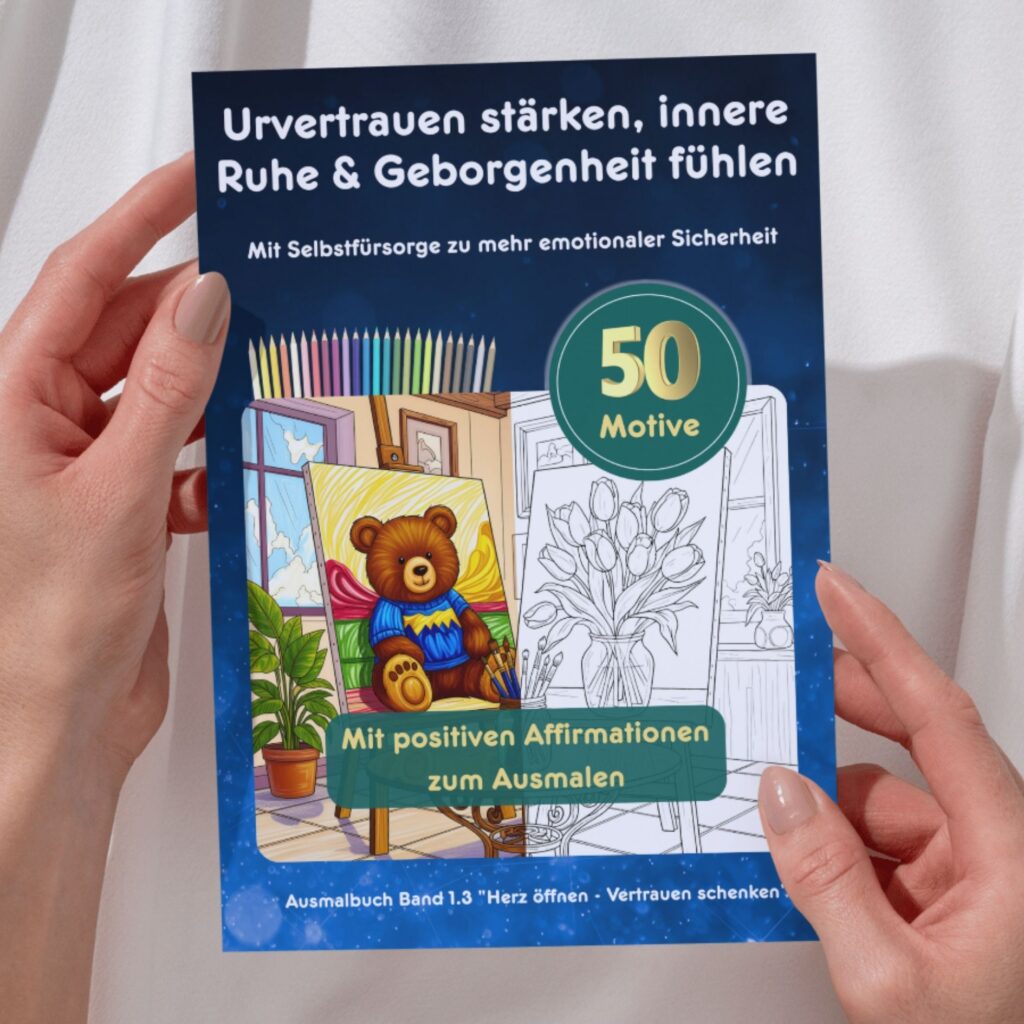
Reconnect with yourself and your inner strength. Our Coloring book „Strengthening basic trust, feeling inner peace & security“ It transforms inner restlessness into conscious self-care. For women who want to create moments emotional security want to experience it. Each of the 50 lovingly designed motifs is accompanied by a positive affirmation tied together.
About the following Amazon link You can view and order it here: https://www.amazon.de/dp/B0FVTMBW3N
Click here for Part 1 „"No basic trust: Why a lack of emotional security in your childhood was crucial."“: https://fidertas-awareness.com/kein-urvertrauen-emotionale-sicherheit
Click here for part 3 „"Building basic trust: Your path to more self-confidence and inner peace!"“: https://fidertas-awareness.com/urvertrauen-aufbauen-innere-ruhe

Click on the following link: https://fidertas-awareness.com/kein-urvertrauen-emotionale-sicherheit
Sarah often feels like an outsider in her own life. Every morning she struggles with exhaustion and a lack of energy. An inner conflict holds her back, preventing her from showing her strength.
These doubts often lead to self-deprecation, and she considers her abilities inadequate.
The constant fear of failure or inadequacy overshadows her daily life. At work, she hesitates to take on responsibility because a deep-seated mistrust influences her actions. Uncertainty is a hindrance. their rise and let them remain stuck in old habits.
She also feels the effects in her relationships. Sarah struggles to form close connections because she constantly fears she's not good enough. This insecurity creates distance where there should be closeness.
She always holds back to minimize the workload for the people around her.
The power of primal trust
Basic trust brings inner peace and stability. It helps overcome self-doubt and look positively towards the future. This opens doors to a fulfilling and happy life.
Sarah's story shows how important it is to understand that Strengthening self-confidence and to find your own path. Are you ready to begin this journey?

Basic trust is like a safe haven in stormy times. It gives you the security to face challenges with confidence.
If it is missing, it dominates Fundamental mistrust, It's like a thick fog, obscuring your vision and sowing doubt. You feel trapped and shy away from making decisions. The fear of abandonment paralyzes you, and you doubt yourself.
This lack of basic trust can lead you to make yourself small and feel like you have no backbone.
Everyday life without basic trust
Sarah demonstrates the effects of fundamental mistrust. She hesitates to accept new challenges at work. Her pessimistic outlook hinders her development, as if she were running on a treadmill without getting anywhere.
The constant inner conflict between courage and fear holds her back. This not only affects her career but also her relationships. Trust is almost always lacking, and genuine intimacy is absent.
Primary mistrust acts like a invisible obstacle in your relationships and makes intimacy more difficult. It fuels the fear of abandonment and leads to self-destructive behavior.
Sarah experiences firsthand how a lack of basic trust creates problems in her relationship. She constantly doubts her partner's affection and finds it difficult to allow intimacy. The fear of being disappointed keeps her trapped.
Shame and self-doubt
In romantic relationships, feelings of guilt and doubt often manifest as signs of deep-seated mistrust. You deny yourself to avoid conflict. Or you constantly accept things you don't like and that are, in some cases, disrespectful. Also, constant... Paternalism in the partnership This could then be a symptom of it.
This leads to an imbalance and weakens the partnership. It is important to set boundaries and differentiate yourself in order to preserve your identity.
A lack of basic trust can also become apparent in friendships. You constantly doubt the intentions of others and struggle to build trust. There are people who mean well, but you don't let them get close.
To deny oneself It's a creeping poison in everyday life. You feel like you have no backbone and often let others cross your boundaries.
Your own desires fade into the background as you try to meet the expectations of others. This behavior pulls you into a spiral of self-deprecation.
The desperate search for recognition
A low self-image prevents Sarah from saying no. She always gives in, even when it hurts inside. She seeks validation in friendships that aren't good for her. Out of fear of rejection, she puts up with everything in order to be accepted.
Sarah's inner voice falls silent in such moments. She barely notices how she is denying herself. Often she feels lost because she is sacrificing her identity just to fit in.
Disclaimer
In cases of (severe) trauma and profound emotional wounds, it is essential to seek professional help. If you are suffering greatly from your experiences, do not hesitate to seek support from therapists or psychologists.
Seeking help is a courageous and important step on the road to recovery.
Many women know the inner conflict between trust and mistrust. A lack of basic trust in partnerships intensifies these fears. Doubts about your self-worth make genuine connections more difficult.
This is exactly what Sarah experiences. Her mistrust leads to an insatiable need for control. She constantly fears her partner might leave her, which prompts her to monitor everything.
Sarah's mistrust began in her youth. Her parents often left her alone, which shattered her basic trust. Today, she constantly feels the fear of being abandoned.
In relationships, this manifests as excessive control. Every move her partner makes is questioned, every message double-checked. This control stifles the relationship, yet she sees no way out.
These inner conflicts may also permeate your everyday life:
Do you often feel weak?, without any momentumStress, emotional strain, and the constant pressure to cope with crises, rob you of your energy?
Inner conflicts and a lack of basic trust also contribute to you feeling... tired and exhausted feel.
Sarah appears confident and organized. She always keeps track of all her appointments, plans her tasks carefully, and is always punctual. But inside, she is often weak and exhausted.
Even upon waking, she feels exhausted, as if she hadn't slept a wink all night. The commute to work becomes an ordeal; every step feels heavy.
In meetings, she smiles politely, nods at the appropriate moments, and shows interest, but her thoughts wander. She thinks about all the tasks that still lie ahead and the peace and quiet she so desperately longs for.
Outwardly, she projects strength. She appears as a confident woman, but she struggles with inner weariness and a constant feeling of exhaustion.
She finds no peace.
She spends evenings alone in her apartment, Overwhelmed by the daily strain, she often retreats with a book or in front of the television to escape into a better world.
She wants to use weekends to recover from the week. But the peace she hopes for usually eludes her. She constantly finds new to-dos and projects to tackle. The feeling of inner restlessness won't let her go. Without doing something, she feels worthless.
The constant overexertion is taking its toll on her and affecting her quality of life. Instead of enjoying life, she feels like a puppet in an endless hamster wheel.
In cases of (severe) trauma and profound emotional wounds, it is essential to seek professional help. If you are suffering greatly from your experiences, do not hesitate to seek support from therapists or psychologists.
Seeking help is a courageous and important step on the road to recovery.
When you suppress your emotions, your inner aggression turns against yourself. Your inner self suffers, and life becomes increasingly difficult.
You're stuck in a constant struggle, to do everything right and to find your way at the same time. No ease and no room for necessary, instructive mistakes. You only works now!
The inner conflict
In different phases of life Are you searching for your identity?. But deep-seated mistrust makes it difficult to recognize your individuality.
You are insecure and seek external validation. The comparison between basic trust and basic mistrust shows how important inner security is for your self-esteem.
A lack of basic trust breeds doubt and insecurity, obscuring your uniqueness. inner critic It's getting louder and louder.
Life phases and self-esteem
Every phase of life presents challenges. Without strong basic trust, it's difficult to set boundaries and see your own uniqueness. Your self-esteem suffers, and you feel like a stranger in your own skin.
The question of what individuality means remains a mystery to you. But there is also strength in the search for your own path. This discovery can help you to walk your path with confidence.
Reconnect with yourself and your inner strength. Our Coloring book „Strengthening basic trust, feeling inner peace & security“ It transforms inner restlessness into conscious self-care.
For women who experience moments emotional security want to experience it. Each of the 50 lovingly designed motifs is accompanied by a positive affirmation tied together.
About the following Amazon link You can view and order it here:
https://www.amazon.de/dp/B0FVTMBW3N
Click on the following link: https://fidertas-awareness.com/urvertrauen-aufbauen-innere-ruhe
Understanding basic trust and basic mistrust opens doors to a fulfilling life. With basic trust, you can overcome self-deprecation and reduce the fear of abandonment.
These findings help to, to resolve emotional blockages and to explore new paths.
Encouragement for self-reflection
Take time to reflect on your life situation:
Share your experiences with us. Your stories and challenges inspire others. Have you already discovered your true path in life, or are you still feeling conflicted?
Your Julia & your Steffen
Disclaimer: This text is for informational purposes only. If you are experiencing trauma, please seek advice from an expert (e.g., a therapist, counselor, or other professional). Therapists).
All images and 3D elements used in this post are from Envato Elements and are used under a valid license.
Keywords: Basic trust vs. basic mistrust, self-abasement, humiliation, fear of being abandoned, my path, self-denial, powerless without any momentum, life is what happens, powerless, tired, exhausted, inner conflict, having no backbone, coping with crises, what individuality means, not letting everything happen, learning to set boundaries, lack of basic trust in partnership, being in conflict.
Sources / Links (without Wikipedia)
Bechert-Möckel, C. (2021, August 28). Basic trust, self-love and successful relationships - how to free yourself from emotional dependencies and find yourself (Podcast). Live, love, let go. https://leben-lieben-lassen.de/urvertrauen-selbstliebe-und-gelingende-beziehungen-wie-du-dich-von-emotionalen-abhaengigkeiten-befreist/
Engeln, H. (2021, October 8). When the body is always tired. geo.de. https://www.geo.de/magazine/geo-wissen-gesundheit/14940-rtkl-erschoepfung-wenn-der-koerper-immer-muede-ist
ib Personality Coaching. (nd). Knowledge: Denial / Denial of reality. ib Personality Coaching. https://www.psychologie-coaching.com/wissen-psychologie/verleugnung/
Schmitt, K. (2012, July 17). Who am I? – Out of the identity crisis. Heiligenfeld. https://www.heiligenfeld.de/blog/raus-aus-der-identitaetskrise
Seiler, LM (2023, May 28). 5 steps to help you reconnect with your primal trust. Laura Seiler Life Coaching. https://lauraseiler.com/verbinde-dich-mit-deinem-urvertrauen/#:~:text=Wenn%20du%20im%20Urvertrauen%20bist,selbst%2C%20der%20deine%20Sch%C3%B6pferkraft%20aktiviert.
Wagner, E. (2024, February 16). These are the biggest signs of fear of loss in women. Berliner Morgenpost. https://www.morgenpost.de/ratgeber/article241690270/Das-sind-die-groessten-Anzeichen-fuer-Verlustangst-bei-Frauen.html

Mental & Mindset Coaching

Personality & Career Profiler

Want to relieve inner tension? Reduce emotional and subconscious stress with anti-stress gifts for women!

Overbearing behavior in a partnership – How to talk about it, set boundaries, and when a separation makes sense.

25 questions and 18 impulses for self-discovery: How to regain more confidence in yourself!
TAKE ADVANTAGE OF OUR FREE TIPS AND INSPIRATION!
THEN PLEASE SUBSCRIBE TO OUR NEWSLETTER

E-book
„"THE POWER OF CHANGE"“

The free e-book "The Power of Change: 5 Strategies to Successfully Replace Negative Habits" is a valuable tool that will help you identify negative habits and replace them with positive behavior.