Authors: Julia Blömer & Dr. Steffen Blömer
Published on:
Updated on:
Short version:
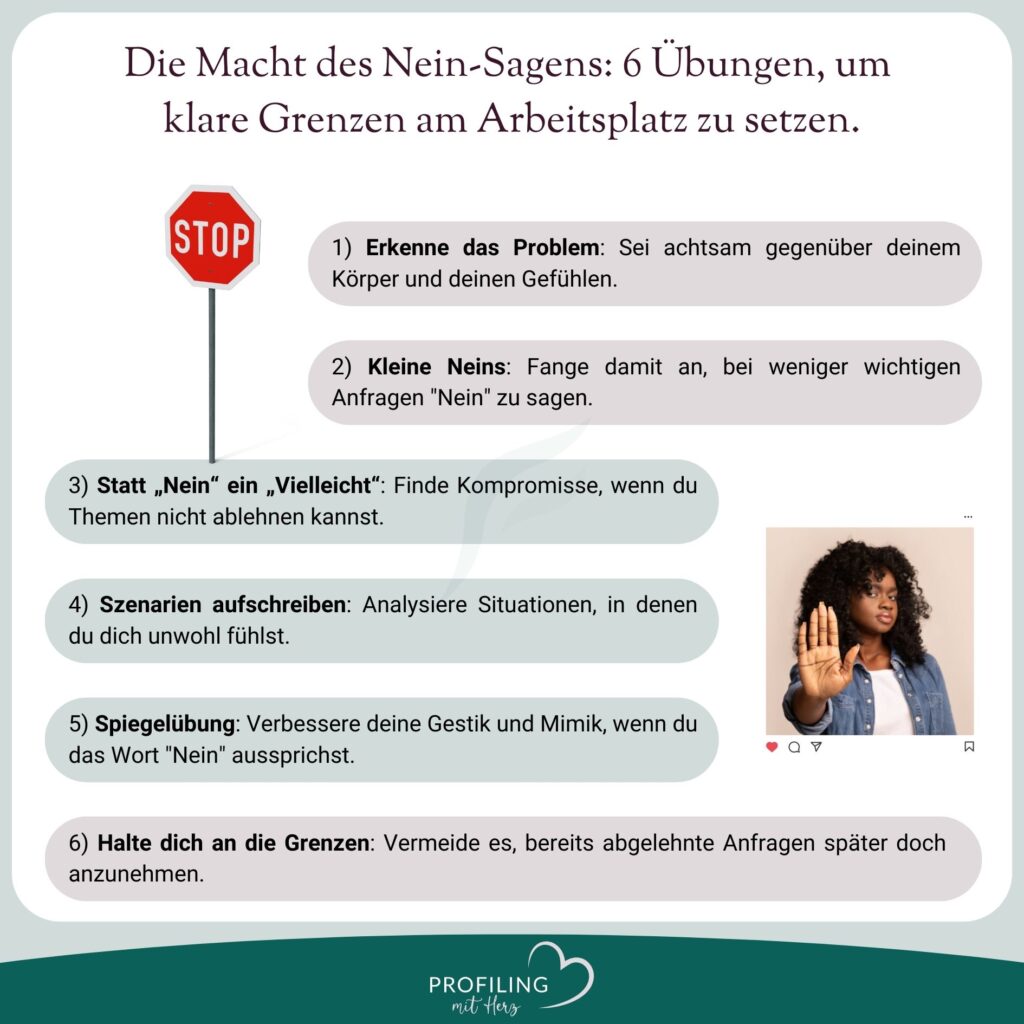
6 practical exercises for setting boundaries:
If you need support, please feel free to sign up for a free initial consultation on. Or just look in our shop, to see if there's something suitable for you.
My name is Lena. I like my job as an office clerk. But every day when I arrive at the office, requests pile up on my desk. I want to be helpful, a team player. Someone my colleagues can rely on. So I say yes – to everything.
With every "yes" I say, the burden on my shoulders grows. I constantly feel overwhelmed because I simply can't say "no" at work.
I spend my breaks clearing away mountains of work that shouldn't even be mine. I notice my energy dwindling and the weekend becoming a desperately needed escape.
What Lena, and perhaps you too, needs to learn is the art of saying no. It's about standing up for yourself and protecting your boundaries. Learning to say no is more than a skill. It's an act of self-care.
Setting boundaries signals to others that your time, energy, and well-being are valuable.
Collea are not automatically friends.
A common misconception in the workplace is equating collegiality with friendship. This doesn't mean you should be unfriendly or standoffish. Rather, it means that professional distance is necessary to effectively set boundaries.
This insight helps you to evaluate requests from your professional environment more objectively and to only take on those tasks for which you are responsible.
Putting colleagues in their place
This means communicating clearly and directly what you can and cannot do. It's about avoiding misunderstandings and ensuring everyone knows and respects their role within the team.
Setting healthy boundaries at work is an ongoing process. It requires practice and patience with oneself.
I've learned to say "no." I've understood that my colleagues don't exclude me when I set boundaries. On the contrary, I've gained their respect. My work performance has improved because I can focus on the tasks that fall within my area of responsibility.
I feel less overwhelmed and am enjoying my work again. I've realized that rejecting others often means supporting myself.
In this blog post, we want to give you tips on how you too can learn, „"No"“ to say. Because Limits at work They have a positive effect on your motivation and well-being.
Why is it so difficult for women in particular to say no?
Deeply ingrained societal expectations and psychological barriers play a role. The fear of rejection and the strong need for recognition compel constant adaptation. Needs and desires recede into the background., Insecurity and self-doubt will not be released.
Societal expectations and the fear of rejection
Even girls learn that they should be nice and helpful. A "no" is interpreted as rejection or rudeness. disturbed mother-daughter relationship in old age and negative beliefs These often make things even more difficult.
This fear is deeply rooted in social norms. Consciousness anchored and is often further intensified by experiences at work. As a result, you constantly have a bad conscience and feelings of guilt.
The need for recognition
The strong desire for others to accept you makes it difficult to..., Saying no. This need leads women to try excessively to meet the expectations of others.
Even if it makes them sick or unwell.
Setting boundaries as a step towards self-assertion
With every boundary that you set, By doing this, you strengthen your self-confidence. You signal to others that your needs are important. This process begins with small steps and grows over time.
By learning to say "no," you open the door to a happy life. You deserve to be heard – and your boundaries deserve respect.
You are valuable, and your time and energy are limited!
Understanding your worth helps you set priorities. You should only make commitments that align with your values and goals. This awareness creates a strong foundation for setting boundaries.
Many people feel uncomfortable when they refuse a task. They think they have to. explain or defend why they made that decision.
You can use these sentences:
Setting boundaries is a skill that develops with time and practice. Every "no" is a step towards greater self-determination. You will be able to achieve your goals more and more often. Overcoming insecurity and self-doubt. As certified life coaches, we can use our experience to help you overcome deep-seated emotional blocks.

In a professional setting, we often encounter situations that require setting boundaries sensitively. When answering "yes" or "no," we must keep our workload in mind.
The idea of saying "no" to the boss can be frightening. But it is possible to stand your ground without appearing disrespectful.
The key lies in communication: Be clear and direct, but respectful. Phrase your "no" as Offer an alternative.
Instead of rejecting outright, try:
„"I understand the importance of this task. Given my current projects, I could focus on it from [date]. Would that be feasible?"“
It's important to maintain a professional distance without appearing unfriendly. Make your boundaries clear by... remain objective and you communicate your needs.
„"I appreciate our conversations, but during work I need to concentrate on my tasks."“ can already be effective.
You must not ignore disrespectful behavior. It is important to address such behavior directly. to address, but in a way that remains professional and does not jeopardize your position.
One approach would be: „"I have noticed that [specific behavior]. I would appreciate it if we treated each other with respect."“
This shows that you are willing to address problems, but are interested in a solution.
A polite "no" consists of the following: building blocks:
Positive feedback + "rejection" + offer a way out
Examples of „polite no“s:
Learning to say no helps women maintain their integrity and improve relationships in the workplace. It empowers you to respect and stand up for your needs while fostering a healthy work environment.
Clear boundaries improve communication and collaboration with colleagues and superiors.
Start with small steps. Say "no" to a request you would otherwise reluctantly accept. Reflect on your personal and professional boundaries and decide where a "no" is necessary.
Seek support from friends, family, or professional advice, If necessary. What step will you take today to strengthen your ability to say no?
„"The greatest freedom lies in being yourself and recognizing and respecting your own boundaries."“ – Emma Goldman
Every small step forward is important when it comes to, happy in my job and to be self-determined. Your needs are important, and it's okay to stand up for them.
Your Julia & your Steffen
Disclaimer: This text is for informational purposes only. If you are experiencing trauma, please seek advice from an expert (e.g., a therapist, counselor, or other professional). Therapists).
All images and 3D elements used in this post are from Envato Elements and are used under a valid license.
KeywordsSetting boundaries, crossing boundaries, recognizing one's own value, learning to say no, saying no respectfully, respect in the workplace, not justifying oneself.
Sources / Links (without Wikipedia)
Gräfe, J. (2022, April 5). Saying no more often: Setting boundaries in everyday work life. Psychologicum Berlin IMG. https://www.psychologicum-berlin.de/blog/oefter-mal-nein-sagen-im-berufsalltag-börsen-stellen/
Güth, J. (2023, April 21). Boundaries at work: Why saying no is important. ZDFheute. https://www.zdf.de/nachrichten/ratgeber/gesundheit/arbeit-job-grenzen-wohlbefinden-ueberlastung-100.html
Hennig, J.-S. (2021, June 28). Learning to say no – 5 tips for setting polite boundaries. foodspring Magazine. https://www.foodspring.at/magazine/nein-sagen-lernen#:~:text=Lass%20dich%20nicht%20von%20der,Nutze%20deine%20Bedenkzeit%20sinnvoll.
Kalawinski, P. (2024, February 1). “Being able to say ”no” for more self-determination. MPS mentoring. https://mps-mentoring.de/blog/self-determination/
Nickelsen, K. (n.d.). Saying no at work. Finally setting boundaries with colleagues. Kirstin Nickelsen. https://www.kirstin-nickelsen.de/nein-sagen
Pagans, M. (2022, November 9). Finally saying no – the ultimate guide. Martha Pagans. https://www.marta-pagans.com/journal/no-say
Paul, R. (2021, June 28). How to learn to say "no" and why it's so important. Treff.Punkt.Erfolg. https://treffpunkt-erfolg.com/blog/wie-du-nein-sagen-lernst-und-warum-das-so-wichtig-ist/
Raeburn, A. (2024, February 9). How (and when) you can say no at work. Asana. https://asana.com/de/resources/how-to-say-no-professionally
Randstad. (2024, February 15). Setting boundaries in the workplace: simply saying no. Randstad. https://www.randstad.de/karriere/karriereratgeber/kommen-stellen-arbeit/
SEQUOYA. (2023, May 23). Why saying no advances women's careers. SEQUOYA. https://sequoya.de/warum-nein-sagen-die-karriere-von-frauen-voranbring/
van Marrewijk, L. (2022, November 30). Saying no: Why is it so difficult for us?. OpenUp. https://openup.de/blog/nein-sagen/
Warkentin, N. (2022, December 13). Justifications: Explaining without justifying oneself. Career Bible. https://karrierebibel.de/justifications/

Mental & Mindset Coaching

Personality & Career Profiler

Want to relieve inner tension? Reduce emotional and subconscious stress with anti-stress gifts for women!

Overbearing behavior in a partnership – How to talk about it, set boundaries, and when a separation makes sense.

25 questions and 18 impulses for self-discovery: How to regain more confidence in yourself!
TAKE ADVANTAGE OF OUR FREE TIPS AND INSPIRATION!
THEN PLEASE SUBSCRIBE TO OUR NEWSLETTER

E-book
„"THE POWER OF CHANGE"“

The free e-book "The Power of Change: 5 Strategies to Successfully Replace Negative Habits" is a valuable tool that will help you identify negative habits and replace them with positive behavior.