

Authors: Julia Blömer & Dr. Steffen Blömer
Published on:
Updated on:
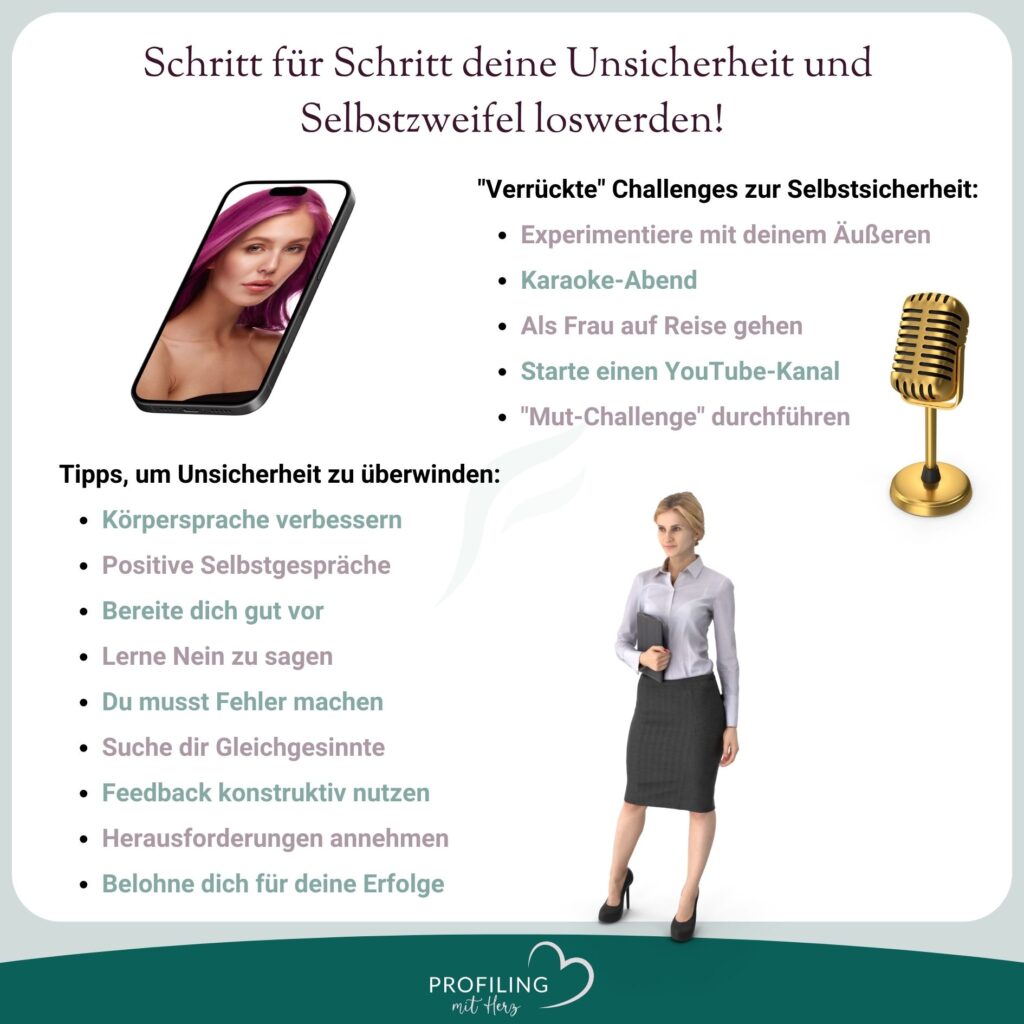
Short version:
These personality traits can influence your insecurity:
Tips to gradually overcome insecurity:
„Crazy“ challenges for self-confidence:
If you need support, please feel free to sign up for a free initial consultation on. Or just look in our shop, to see if there's something suitable for you.
Understanding insecurity and self-doubt
Both are like dark clouds obscuring our sky. They make us hesitate and hinder our development, whether in our careers, relationships, or everyday lives. They prevent us from developing our abilities and achieving extraordinary things.
This blog post will serve as your lighthouse, guiding you through stormy times. We'll show you how to... Job insecurity You overcome it and leave self-doubt behind in your relationship. Because the fear, „not being enough„"This can severely restrict us in our daily lives.".
We immerse ourselves in a world where you learn to master uncertainty in life and Overcoming self-doubt.
Embark on a journey of personal transformation. At the end, you will find a radiant version of yourself. A version freed from the chains of insecurity. A woman ready to embrace life in all its facets.
The foundation for our self-image and perception of ourselves is laid in childhood. Self-doubt usually has its roots in this. roots in childhood, especially if we were frequently reprimanded for our mistakes. This often arises negative beliefs, which haunt us for a long time.
These early experiences have a profound impact on our self-confidence. This is intensified when parents set excessively high expectations or view love and recognition as a reward for meeting those expectations, instead of supporting us unconditionally.
In our professional lives, social circles, and personal relationships, we are constantly faced with challenges. These situations often reactivate old insecurities. A critical comment at work or conflicts in a relationship can reopen old wounds. Immediately, we feel a guilty conscience and the critical inner voice appears.
Self-doubt paralyzes us, making us incapable of making decisions. Or it leads us to constantly reverse decisions we've already made. question.
Learn, confidently and lovingly Setting clear boundaries with our 4-week plan.
These questions will help you better understand your own story and actively work on a healthy self-image. Your past does not define your future. You have the power to reinvent yourself, and with every step, your self-confidence grows.
The Big Five Model offers a scientific method to help you personality to determine. Each dimension of the Big Five comprises two opposing poles. For example, "sensitivity" is opposed to "emotional stability".
Both "poles" are present within you, but to varying degrees. Each of these Big Five dimensions contains six so-called facets.
The facets reveal how you behave in situations and how you shape your life.
We won't go into further detail here to avoid exceeding the scope of this blog post. Instead, we'll show you examples so you can better understand your previous behavior, which was characterized by insecurity and self-doubt.
Anna is a dedicated employee in a dynamic company. She is intelligent and competent, but has a tendency to downplay her achievements and abilities.
Anna regularly finds herself in situations where she hesitates to express her opinion in meetings, even though she has valuable ideas. Humility She holds back. She fears being perceived as boastful or smug if she highlights her achievements.
This job insecurity and the fear of not being good enough intensify when a promotion is on the horizon. She realizes that despite her competence and dedication, she is not being considered.
On the other end of the spectrum is the positive self-presentation. People who score higher in this area tend to present themselves and their achievements confidently. They seize opportunities to showcase their skills and abilities. Successes to share. This way, they will be seen and recognized by others.
The balance between Humility Positive self-presentation is crucial. If Anna were able to present her achievements appropriately, she could overcome her own insecurity and self-doubt.
She learns to communicate her successes confidently, but not arrogantly. This opens the door to new career opportunities for her. At the same time, it boosts her self-esteem.
Lara, an enthusiastic amateur cook, loves to invite friends over to her home. Despite her talent and her guests' enthusiasm for her cooking, Lara displays a moderate level of self-confidence.
She tends to downplay her cooking skills in large groups. She emphasizes that it's "just a little experiment" or that "anyone can do it this well." This behavior prevents Lara from accepting praise and recognition.
Lara's talents unfold while cooking with her best friend Susanne, with whom she feels safe and accepted. social self-confidence. She shares her recipes and cooking experiences with Susanne.
In these moments, Lara overcame her self-doubt. She enjoys being the center of attention and sharing her passion with others.
The dilemma lies in the gap between her moderate level of self-confidence and her social self-confidence, which emerges in a familiar environment.
Lara's challenge lies in harmonizing these two facets of her personality. By learning to confidently showcase her talents outside her comfort zone, Lara can overcome her social anxiety.
Carola, a dedicated software developer, works at a burgeoning tech startup. In this highly dynamic environment, the pressure to deliver innovative solutions is immense. This leads her to experience professional insecurity and self-doubt.
Carola is distinguished by her technical expertise. At the beginning of her career at the start-up, Carola tended to react more readily to stress under pressure. Long working hours, tight deadlines, and the fear of not delivering quickly enough triggered a high level of stress for her.
She often finds herself at a crossroads. This lies between experiencing stress and a high resistance to pressure.
She felt overwhelmed by the sheer number of tasks and the pressure to meet expectations, which she dissatisfied and unhappy did.
Over time, however, Carola realized that this reaction to stress was not effective, especially in an environment that demands flexibility and speed. She began to develop techniques to Stress management to apply in order to their Stress resistance to strengthen.
This included regular breaks during the workday, meditation, time management, and establishing boundaries between work and private life. She had identified one of the causes of her insecurity and actively worked on it.
Their increased Stress resistance It enabled her to work more creatively and productively. She did not neglect her health and well-being in the process.
Anja and her partner Felix have been in a relationship for several years. They share many interests and have built a deep connection with each other.
Anja is by nature rather interior-oriented. She draws satisfaction and energy from her thoughts, feelings, and time spent with a good book.
However, Anja's strong inward focus sometimes leads her to hesitate in openly communicating her desires. She fears being perceived as selfish or provoking conflicts if her needs differ from those of her partner.
Felix, on the other hand, has a very pronounced External orientation. He is a person who actively seeks the company of others, whether in social gatherings, during shared activities, or in everyday conversation. Felix feels energized and alive when he shares his thoughts and experiences with others.
Anja values periods of silence and solitude to regenerate and sort out her thoughts. She feels overwhelmed and stressed when she doesn't have enough space for herself. Felix often takes this personally.
He misinterprets Anja's need for solitude as a sign of neglect, and as a lack of interest in his friends and social activities.
Anja begins to express her needs more openly. to communicate. She shows more initiative in planning joint activities and meeting friends.
At the same time, Felix and Anja are working together on a healthy balance to find a balance between inward and outward orientation. They understand that it is important to make room for each. needs to create, but also to experience moments together.
Through this process, they learned to accept and appreciate the differences in their personalities. They managed to overcome their self-doubt and to communicate on equal terms.
Your Body language It speaks volumes – often more than you realize. It influences how others see you and how you feel.
An upright posture, firm eye contact, and a confident smile work wonders to overcome insecurity and self-doubt. You can To be reserved yet self-confident radiate.
A confident posture boosts your self-confidence and positively influences how you are perceived by others. Conversely, awareness of your strength helps you overcome social insecurities.
Daily practice
Stand or sit up straight, take deep breaths, and maintain eye contact during conversations. Always lift your head and chin, and take your hands out of your pockets. And be friendly. Smile don't forget.
These small changes in your daily routine can have a big impact on how You seem confident. By consciously using your body language, you build a bridge between your inner state and the outside world.

Together we explored how you can overcome insecurity step by step. Understanding your personality is crucial for understanding your insecure behavior and overcoming your self-doubt.
Success arises from small, consistent steps. From the willingness to challenge oneself. And from the ability to persevere despite... Don't give up after setbacks.
What challenges will you start with? What will you change in your life?
If you're looking for inspiration, tips, and personal support, then sign up for the Newsletter a: https://fidertas-awareness.com/newsletter/
There we share exclusive content that will help you achieve your goal of self-confidence.
Every journey begins with the first step. And this one... first step This could be the beginning of something wonderful. A life full of Joy of life, which you desire and deserve.
Your Julia & your Steffen
Disclaimer: This text is for informational purposes only. If you are experiencing trauma, please seek advice from an expert (e.g., a therapist, counselor, or other professional). Therapists).
All images and 3D elements used in this post are from Envato Elements and are used under a valid license.
KeywordsOvercoming insecurity and self-doubt, overcoming social insecurity, causes of childhood self-doubt, overcoming one's own insecurity, insecurity at work, getting rid of self-doubt.
Sources / Links (without Wikipedia)
7Mind. (nd). Overcoming self-doubt: 3 tips for dealing with insecurity. 7min. https://www.7mind.de/magazin/selbstzwei-tipps-definition
Dautfest, P. (2023, November 22). Overcoming self-doubt: What can be done about insecurity?. DONNA. https://www.donna-magazin.de/leben-liebe/psychologie/selbstzwei/#selbstzwei-ursachen-kindheit
Gielas, A. (2018, September 12). Is modesty a positive thing?. Psychology Today. https://www.psychologie-heute.de/leben/artikel-detailansicht/39459-ist-bescheidenheit-positiv.html
Hafke, A. (2020, December 28). Increase stress resistance: How you can protect yourself from internal and external stress. HelloBetter. https://hellobetter.de/blog/stress Resistance/
Half, R. (2022, August 15). Don't be afraid: 9 tips to help you overcome insecurities at work. Robert Half. https://www.roberthalf.com/de/de/insights/karriereentwicklung/7-methods-how-to-overwind-uncertainties-im-job
Herger, D. (2023, May 5). How much "me time" does your relationship need?. DER STANDARD. https://www.derstandard.de/story/2000146089552/wie-viel-me-time-braucht-ihre-beziehung
Head over heels. (2020, May 11). Courage & Joy of Life Challenge. Head over heels. https://www.herz-kopf.com/portfolio-item/mut-lebensfreude-challenge/
Hintermüller, C. (2022, October 14). Overcoming self-doubt and insecurity: 5 unusual tips - how you can succeed!. Carmen Hintermüller, Consciousness & Psyche. https://www.selbstwertgefuehl-staerken.at/selbstzweifel-ueberwinden/
Laura. (2024, February 7). Projecting self-confidence: 10 tips for a confident appearance. Life Idealists. https://www.lebensidealisten.de/blog/selbstbewusstsein-ausstrahlen-10-tipps-fuer-ein-selbstbewusstes-auftreten/
LINC. (2022, April 22). The Big Five Model: A sound assessment of personality. LINC. https://linc.de/das-big-five-modell/
Lukaßen-Held, D. (2018, May 11). Projecting confidence: Five tips for convincing body language. Port41. https://www.port41.at/artikel/selbstsicher-auftritt-fuenf-tipps-fuer-eine-ueberzeugende-koerpersprach
Meet Your Master. (2020, December 11). Boost your self-confidence: 7 tips you can implement immediately. Meet Your Master. https://www.meetyourmaster.de/de/blog/sgesundheit-staerken
Noel, K., & Lenke, M. (2016, April 5). Use body language effectively: These 8 tricks will instantly make you appear more confident.. Business Insider. https://www.businessinsider.de/karriere/arbeitsleben/koerpersprach-mit-der-ihr-selbstconsciouser-effekt-2016-4/
Ott, F. (2023, February 20). Self-confidence: 8 tips on how to become more self-confident. HubSpot Blog. https://blog.hubspot.de/sales/selbstsicherheit
Ratković, S. (2023, October 7). New hairstyle, new life? Why I had my hair cut into a bob. RetroCat. https://retrocat.de/2017/03/21/neue-frisur-neues-leben-warum-ich-meine-haare-zum-bob-schneid-liess/
STERN.de. (2022, April 6). Method for more self-esteem: The “7-2-1 rule” helps you feel good about yourself.. stern.de. https://www.stern.de/lifestyle/leben/psychologie–mit-der-7-2-1-regel-schafffst-du-mehr-selbstwertgefuehl-31740566.html

Mental & Mindset Coaching

Personality & Career Profiler
Want to relieve inner tension? Reduce emotional and subconscious stress with anti-stress gifts for women!

Overbearing behavior in a partnership – How to talk about it, set boundaries, and when a separation makes sense.

25 questions and 18 impulses for self-discovery: How to regain more confidence in yourself!
TAKE ADVANTAGE OF OUR FREE TIPS AND INSPIRATION!
THEN PLEASE SUBSCRIBE TO OUR NEWSLETTER

E-book
„"THE POWER OF CHANGE"“

The free e-book "The Power of Change: 5 Strategies to Successfully Replace Negative Habits" is a valuable tool that will help you identify negative habits and replace them with positive behavior.