

Authors: Julia Blömer & Dr. Steffen Blömer
Published on:
Updated on:
🎤 Listen to the blog post (by "Lena", AI voice):
Short version:
Difference between basic trust and trust:
Examples of self-denial through childhood experiences:
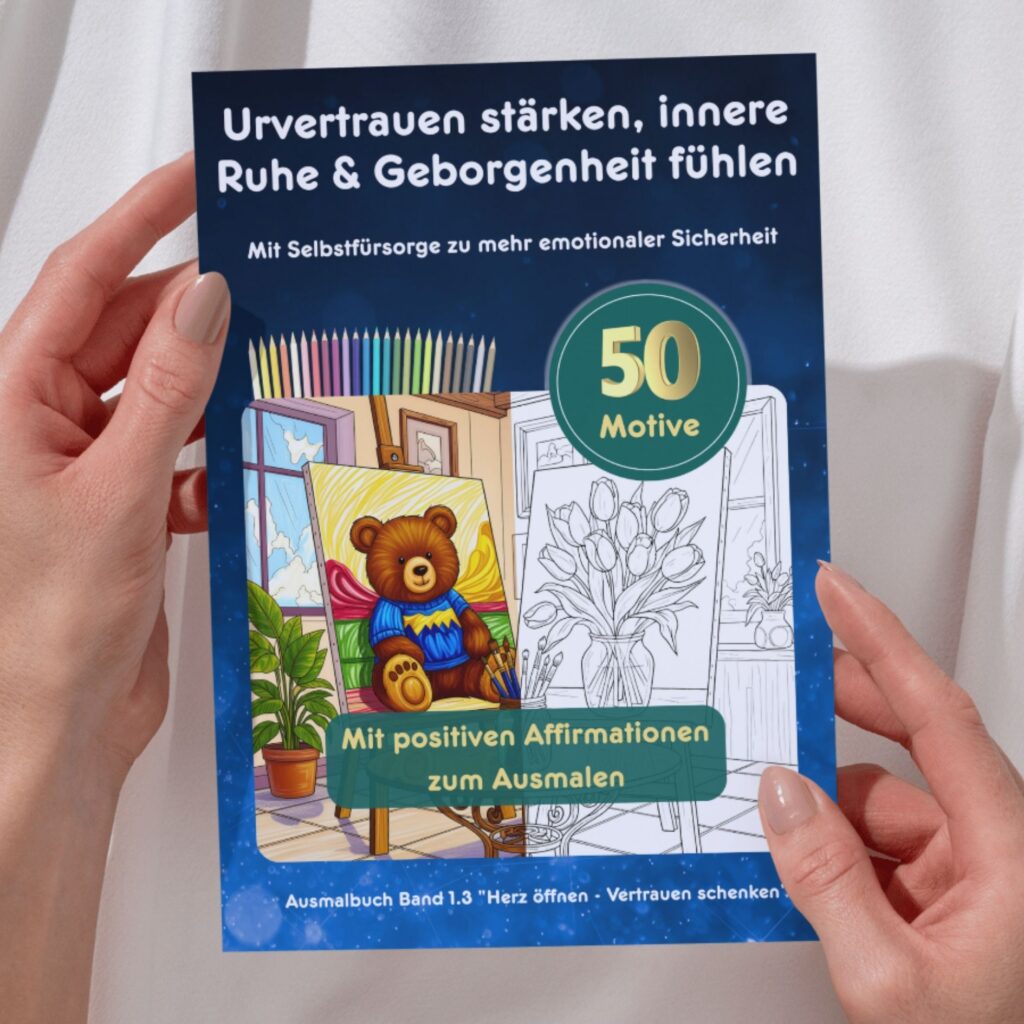
Reconnect with yourself and your inner strength. Our Coloring book „Strengthening basic trust, feeling inner peace & security“ It transforms inner restlessness into conscious self-care. For women who want to create moments emotional security want to experience it. Each of the 50 lovingly designed motifs is accompanied by a positive affirmation tied together.
About the following Amazon link You can view and order it here: https://www.amazon.de/dp/B0FVTMBW3N
Click here for part 2 „"Have you never truly arrived in life? Discover the secret of primal trust and primal mistrust!"“: https://fidertas-awareness.com/urvertrauen-staerke-urmisstrauen-zweifel/
Click here for part 3 „"Building basic trust: Your path to more self-confidence and inner peace!"“: https://fidertas-awareness.com/urvertrauen-aufbauen-innere-ruhe

Sarah grew up in a small town, often feeling misunderstood. Her parents were busy with work, which meant she lacked the emotional warmth and security she so desperately needed.
These circumstances led Sarah to suppress her emotions. In particular, the anger from her childhood, resulting from her mother's lack of attention, remained deeply ingrained within her.
Today, as an adult, Sarah feels the effects of her lack of basic trust. Uncertainties They influence not only their interpersonal interactions, but also their professional ambitions and personal goals.
Questions like „"Why can't I trust others?"“ or „"Why do I find it difficult to accept myself?"“ accompany their everyday lives.
Lack of basic trust: The significance for us
Basic trust It is the invisible foundation of our emotional well-being. It influences how we conduct relationships and navigate the world. Without this trust, a feeling of insecurity arises.
Like a tree without roots that topples in the slightest storm, a life without basic trust can be unstable. A sense of security in childhood is fundamental for a stable personality.
What happens when this (inner) security is lacking and emotional needs are not met?
Emotions as a guidepost
Sarah desperately seeks validation and tries to heal the lack of maternal love. But without recognizing her own worth, this search remains fruitless. To protect herself, she believes she must hide her emotions. In doing so, she only intensifies the inner emptiness.
It's never too late to regain lost trust. If you have the courage to accept your emotions, you will experience well-deserved security.
Change begins within you – and it's an exciting journey full of new possibilities. Embrace it and experience how you build a stable home from an uncertain foundation.
Basic trust is the feeling of safety and security that you develop in your early years. It gives you the certainty that the world is a safe place and that you can rely on others.
This trust forms the basis for your psychological stability and strongly influences your emotional well-being.
The strength in everyday life
With primal trust Do you feel safe? and you can build healthy relationships. It strengthens your self-confidence and gives you the assurance to overcome challenges. A lack of basic trust makes you insecure and often isolated.
A stable sense of basic trust enables you to deal with inner peace and to go through life with self-confidence. It is the key to a fulfilled and balanced existence in which you can truly be yourself.
Reflection questions:
Basic trust It develops in the first years of life and forms the basis for a feeling of security in the world. It is closely linked to the bond with primary caregivers.
Trust In contrast, it develops later and builds on experiences and interactions with the environment. It is more specific and often situation-dependent.
| feature | Basic trust | Trust |
| Origin | Early childhood | Later life stages |
| Relation | General sense of security | Specific relationships and situations |
| dependence | Directly from the bond to caregivers/reference persons | Experiences and social interactions |

Early childhood experiences shape your basic trust Crucial. Even the strongest seed won't thrive without rain and light, just like a plant. Without this emotional support, you often feel insecure in the world.
Children who have been emotionally neglected often experience a lack of security and belonging. These insecurities affect their self-image and interpersonal relationships.
A lack of basic trust often leads to anxiety and social withdrawal in adults.
This theory This underlines how important early attachments are in everyone's life. The foundation for emotional stability, a positive self-image, and trust in others is laid through our childhood relationships.
They influence how we perceive and shape relationships in adulthood.
You should understand and recognize these connections, as they shape your behavior and emotions. Through targeted self-reflection and professional support, it is possible to break old patterns and lead a fulfilling life.
In cases of (severe) trauma and profound emotional wounds, it is essential to seek professional help. If you are suffering greatly from your experiences, do not hesitate to seek support from therapists or psychologists.
Seeking help is a courageous and important step on the road to recovery.
In your childhood, your mother's love lays the foundation for your trust. Without this affection You often feel insecure. The lack of security leads you to suppress your emotions and believe your feelings are less valuable.
Even as an adult, your relationship with your mother influences you, because it shapes your attachments.
Some women experience distance or rejection from their mothers. Others feel they have never received enough love or that they have to pretend to be someone they're not in order to be loved.
These experiences make it difficult to love and accept yourself. This has a lasting negative impact on your relationships and enjoyment of life.
You may be unconsciously searching for the love and recognition you lacked from your mother. This search can lead to... stressful relationships lead.
Or you keep people at a distance because you've learned that love is uncertain. You find it difficult to develop emotional trust and build deep connections with others.
It is important to understand the effects of a lack of maternal love without condemning all mothers.
In every generation, mothers face their own challenges and problems. Often, they themselves come from difficult situations that have affected their ability to give love and care.
Many mothers do not intentionally act harmfully. Rather, they are often trapped in a vicious cycle of pain and unresolved trauma.
During my own childhood, I was not allowed to fully experience the meaning of unconditional love. This had an impact on my adult life.
I often felt overshadowed by my mother, who was emotionally unavailable. This distance made it difficult for me to build trust with other people. In many situations, I sought validation and love, yet it never seemed to be enough.
I longed for closeness but was always insecure. This led me to pretend to be someone I wasn't in relationships. It wasn't until my life coach training that I learned these patterns were rooted in my early experiences.
Today, trust and openness are no longer foreign concepts to me. The past has shaped me, but it no longer dictates my actions.
Through my life coaching training, I learned that true intimacy grows from self-acceptance. This realization encourages me daily to consciously shape my life and cultivate positive relationships.
Perhaps you learned as a child to... To hide feelings. Emotional distance It's a defense mechanism and hangs over your life like an invisible shadow. If you don't express your anger and pain, these emotions build up.
The societal expectation to be strong reinforces the tendency to suppress your feelings. The pressure that To meet the expectations of others, plays a role in this.
This often leads to you being stuck in an endless loop of self-doubt and it creates uncertainty. This makes it difficult to find and follow your own path.
Self-denial and inner distance
By denying your true needs, you avoid conflict, but this only weakens your self-confidence even more.
An isolation from yourself develops, which acts like an invisible wall between you and authentic relationships stands.
These suppressed feelings affect your daily life. You struggle with gaining recognition and expressing your true emotions. Ultimately, you may long for more understanding and closeness, but you're unsure how to achieve it.
Reflection questions:
To deny oneself, This is a common phenomenon in our conformist society. We suppress our needs because we want to follow societal expectations or please others.
This urge arises from the fear of rejection or the desire to be recognized and accepted.
If you constantly suppress your desires, your self-confidence suffers. You listen less to your inner voice and more to external opinions. This increasingly separates you from your true feelings.
Your confidence in your decisions is waning. You increasingly doubt your ability to find the right path for yourself.
Reconnect with yourself and your inner strength. Our Coloring book „Strengthening basic trust, feeling inner peace & security“ It transforms inner restlessness into conscious self-care.
For women who experience moments emotional security want to experience it. Each of the 50 lovingly designed motifs is accompanied by a positive affirmation tied together.
About the following Amazon link You can view and order it here:
https://www.amazon.de/dp/B0FVTMBW3N
Click on the following link: https://fidertas-awareness.com/urvertrauen-staerke-urmisstrauen-zweifel/
Click on the following link: https://fidertas-awareness.com/urvertrauen-aufbauen-innere-ruhe
Through emotional neglect Suppressed emotions in childhood can lead to a lack of basic trust. A weak bond with the mother often leaves deep scars.
But recognizing these causes is the first step to healing. This way you can heal from the lack of maternal love and process feelings you've never brought to the surface.
„"A heart full of (primal) trust knows no fear."“ - Unknown
We encourage you to share your thoughts and experiences in the comments:
Your Julia & your Steffen
Disclaimer: This text is for informational purposes only. If you are experiencing trauma, please seek advice from an expert (e.g., a therapist, counselor, or other professional). Therapists).
All images and 3D elements used in this post are from Envato Elements and are used under a valid license.
Keywords: lack of basic trust, suppressing emotions, healing missing mother love, basic trust, suppressed feelings, suppressed anger in childhood, feeling secure, what destroys basic trust, trust in oneself, emotional well-being, lack of affection in childhood, denying oneself.
Sources / Links (without Wikipedia)
Brandt, T. (2024, May 26). How to rediscover your basic trust: Causes and paths to more security, peace and joy in life. Intu Wonderland. https://www.intuwonderland.de/wie-du-dein-urvertrauen-wiederfinden-kannst
Educator channel. (nd). John Bowlby's attachment theory. Educator channel. https://www.erzieherkanal.de/bindungstheorie-john-bowlby
Faralis, A. (13AD). Emotional neglect of children and its consequences. Children's Aid News Blog | German Life Bridge. https://blog.lebensbruecke.de/start/emotionale-vernachlaessigung
Heckl, M. (2024, February 28). 9 Signs of Emotional Neglect in Childhood. https://scilogs.spektrum.de/marlenes-medizinkiste/emotionale-vernachlaessigung-in-der-kindheit/
Kasten, Prof. Dr. Dr. H. (2001, September 3). Sibling rivalry. www.familienhandbuch.de. https://www.familienhandbuch.de/familie-leben/familienformen/geschwister/geschwisterrivalitaet.php
Korz, J., & Janson, S. (2016, February 26). Self-denial in psychology: Lack of self-love instead of job success. Best of HR. https://berufebilder.de/selbstverleugnung-psychologie-selbstliebe-erfolg/#selbstverleugnung-das-sagen-psychologen
LIMES Castle Clinic Mecklenburg Switzerland. (nd). Lack of maternal love and long-term consequences in adulthood. LIMES Castle Clinic Mecklenburg Switzerland. https://www.limes-schlosskliniken.de/blog/gefuehlskalte-mutter/#:~:text=Akzeptanz%20zu%20finden-,Fehlende%20Mutterliebe%20und%20Sp%C3%A4tfolgen%20im%20Erwachsenenalter,leiden%20unter%20einem%20geringen%20Selbstwertgef%C3%BChl.
Martin, ES (2022, December 21). Overly critical parents: Their influence on child development. I am a mother. https://ichbinmutter.com/erziehung/erziehung-von-kleinkindern-und-kindern/emotionale-erziehung/ueberkritische-eltern-einfluss-auf-die-entwicklung-des-kindes/
Pichler, Dr. R. (2024, January 19). Strengthening basic trust: A path to greater inner stability and joy in life. Dr. Reinhard Pichler. https://reinhardpichler.at/persoenlichkeit/urvertrauen-staerken/
Schmitt, K. (2022, February 12). Trust – the basis for a good life. Heiligenfeld. https://www.heiligenfeld.de/blog/vertrauen-die-basis-fuer-ein-gutes-leben
Schwenkkraus, R. (2024, June 26). Basic trust – The foundation for a carefree life. Head pattern. https://www.kopfmuster.de/urvertrauen-die-basis-fuer-ein-unbeschwertes-leben/
Wittiber-Schmidt, S. (2024, July 1). Why suppressed emotions cause symptoms and what you can do about it. Stefanie Wittiber-Schmidt. https://stefanie-wittiber-schmidt.de/unterdrueckte-emotionen-symptome/

Mental & Mindset Coaching

Personality & Career Profiler

Want to relieve inner tension? Reduce emotional and subconscious stress with anti-stress gifts for women!

Overbearing behavior in a partnership – How to talk about it, set boundaries, and when a separation makes sense.

25 questions and 18 impulses for self-discovery: How to regain more confidence in yourself!
TAKE ADVANTAGE OF OUR FREE TIPS AND INSPIRATION!
THEN PLEASE SUBSCRIBE TO OUR NEWSLETTER

E-book
„"THE POWER OF CHANGE"“

The free e-book "The Power of Change: 5 Strategies to Successfully Replace Negative Habits" is a valuable tool that will help you identify negative habits and replace them with positive behavior.