Authors: Julia Blömer & Dr. Steffen Blömer
Published on:
Updated on:
Short version:
Consider these areas to identify belief systems:
Reflect on belief systems:
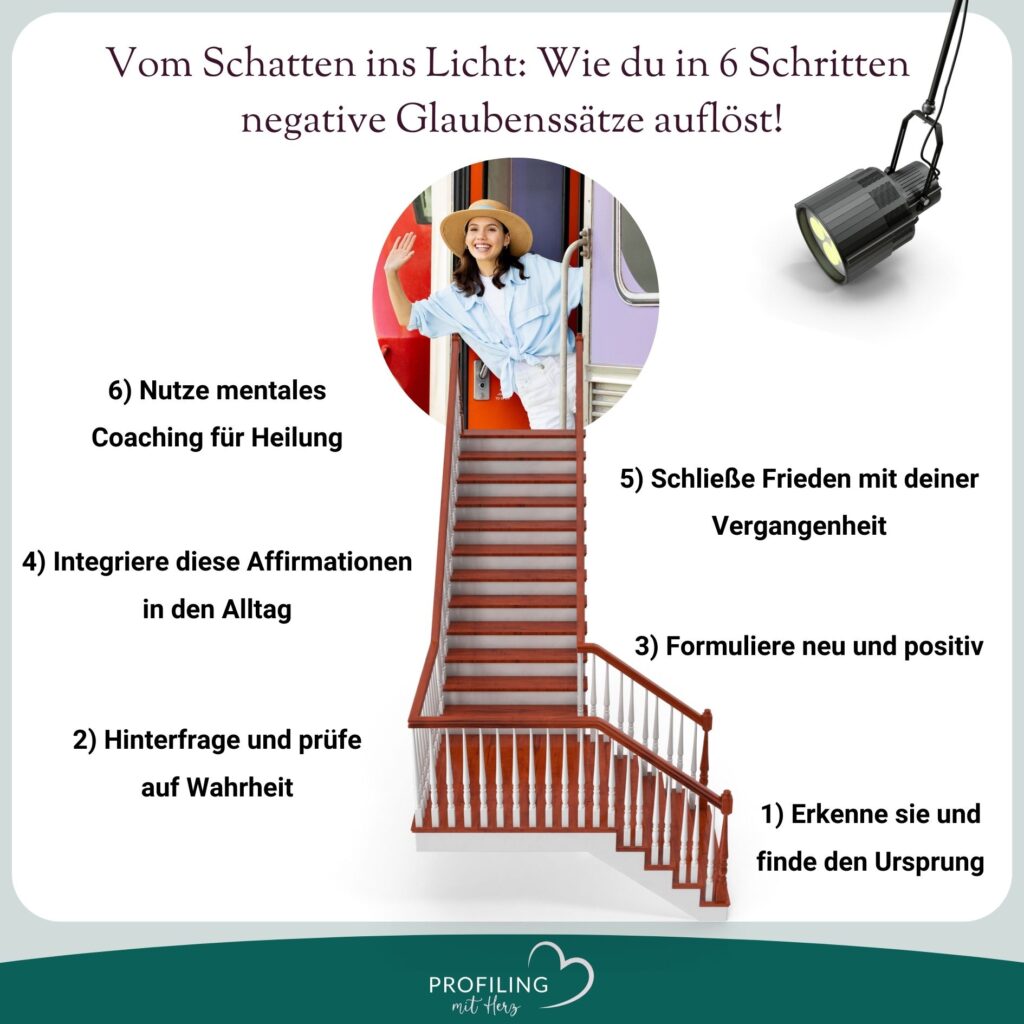
Dissolve limiting beliefs in 6 steps:
1. Recognize them and find their origin
2. Question and verify for truth
3. Rephrase and improve your message.
4. Integrate these affirmations into your daily life.
5. Make peace with your past
6. Use mental coaching for healing
„"Thinking positively" alone is not enough. Eight impulses for a fulfilling life:
If you need support, please feel free to sign up for a free initial consultation on. Or just look in our shop, to see if there's something suitable for you.
This negative beliefs They had a firm grip on Helena and had an extremely paralyzing effect on her entire being. They were like dark, heavy clouds that clouded her view of life.
They prevented her from clearly recognizing the beauty and opportunities that were available to her.
In your career: Overcoming self-doubt
Helena works in a modern company, but despite her successes, she has always felt like a fraud. The belief „"I'm not good enough."“ paralyzed her.
One day she decided to do this destructive thoughts to question things. She began to document her successes and skills and soon realized how unfounded her insecurities were.
With each step forward she consciously recognized, the fog of self-doubt lifted. This gave rise to a new and self-confident Helena Platz.
In her relationship with her mother: Breaking old ties
Her relationship with her mother was strained and the source of many negative beliefs. „"Nobody really loves me."“ was an echo of the emotional distance Helena had felt as a child.
The disproportionately high Expectations and the mother's overprotectiveness made things more difficult Adult relationship.
To break this cycle, she initiated open conversations with her mother. The discussions weren't always easy, but they helped both of them heal old wounds and clear up misunderstandings.
Helena learned to see the love of her mother, which had always been there.
Partnering with Alex: Dare to trust
„"I can't trust anyone."“ This belief had prevented Helena from fully committing to Alex.
Her fear of being hurt was immense. Her mistrust strained the relationship. She knew it was time to face her fears.
She worked on her self-confidence and developed the ability to openly express her feelings within the relationship. needs to communicate. Alex met her with patience and understanding. This allowed her to tear down the walls around her heart and open herself up to a balanced relationship design.
Today, Helena lives a life shaped by positive beliefs. The journey was long and not easy. Helena understood that change is possible.
She has learned to love herself, to recognize her strengths and to communicate on equal terms.
„"Today you are where your thoughts have taken you. Tomorrow you will be where your thoughts take you."“ – James Allen
In this blog post, we want to look at how you can recognize belief systems., rephrase and transform your life.
Imagine your mind is like a garden where both blooming flowers and weeds thrive. The thoughts in your head are the seeds.
Positive such as negative beliefs They arise from these seeds, influenced by the experiences we gather and the feelings we attribute to them.
A belief about money, for example, can stem from childhood. Have your experiences taught you that „"Money is the root of all evil."“. This belief can lead to financial anxieties in adulthood.
Have you ever noticed your parents coming home from work stressed and dissatisfied? One common belief about work is: „"Work is always stressful and makes you unhappy."“ Your mindset might cause you to miss out on career opportunities that would actually be a good fit for you.
If you don't feel loved or valued, thought patterns develop that negatively impact your self-esteem. The fear that failing to meet the expectations of others, It paralyzes us.
Our thoughts, Feelings and beliefs are closely intertwined. They influence how we see the world and what beliefs we hold about ourselves and others:
To maintain the garden
To cultivate positive beliefs, you must learn to consciously control your thoughts. Start by recognizing the weeds – the negative beliefs – and carefully removing them from your mind.
Instead, sow seeds of love, trust, and self-esteem. Nurture them with care and positivity. Watch as your inner garden grows into a place of beauty and strength.
In the following chapters you will learn six steps to identify and sustainably change your beliefs.
Each of us harbors views that influence our lives in a variety of ways.
Consider the following areas of life:
Belief systems are usually formed in divided into three types:
Belief systems about causes and connections
These describe how we think and believe that certain events or situations arise. Or why certain situations are the way they are.
Examples:
Belief systems about meaning
Such thought patterns relate to the evaluation of situations or experiences and give them a specific meaning.
Examples:
Beliefs about one's own identity
These reveal who we believe ourselves to be and how we perceive ourselves.
Examples:
Certain words point to limiting beliefs.
These include, for example, „always“, „nobody“, „everyone“, „never“, „must“, „cannot“, „should“, and „will not“.
Examples:
To overcome your limiting thought patterns to recognize, Start by observing your thoughts and feelings. Keep a (digital) journal, noting your thought patterns and the situations in which they occur.
Ask yourself:
By recognizing your limiting beliefs, you take the crucial first step out of darkness and into light. You possess the power to shape your life according to your own desires.
Remember Beth Harmon from "„The Queen's Gambit“(Netflix, 2020), whose complex past was marked by an addiction to tranquilizers. Despite these challenges and the male-dominated world of chess, she rises to become a magnificent master.”.
Similar to Beth, you need to understand where your limiting beliefs come from and confront them.
Ask yourself: What experiences have shaped my beliefs?
In the popular television series „Suits“(USA Network, 2011) Harvey Specter questions prevailing assumptions in order to win his cases.
He uses this strategy to expose the weaknesses in his opponents' arguments and lead his clients to victory.
Like Harvey, we need to critically examine our beliefs: Is this belief objectively true? Or does it merely stem from an interpretation of my experiences?
The Netflix series „Self Made“(2020) tells the story of Madam CJ Walker. An extraordinary woman who, despite challenges and societal resistance, builds her cosmetics empire.
The series impressively demonstrates how Madam Walker transforms negative beliefs into positive affirmations and uses them as powerful tools.
A central element of their strategy is the transformation of their internal dialogue. „"I can't do that."“ to „"I can and will be successful."“.
This transformation of thinking enables her to overcome barriers and become a pioneer in the business world.
The two main actors from the popular Netflix series „Grace and Frankie“(Netflix, 2015), must redesign their lives after profound changes.
Over the course of the series, they learn to integrate new beliefs and habits into their everyday lives.
This change involves adapting to new life circumstances. It encompasses deeper self-acceptance and the awareness that it is never too late for a new beginning.
The message of the series is clear and inspiring: Anchor positive beliefs in everyday life to enjoy every moment and rediscover yourself in every phase of life.
„Fleabag“(Amazon Prime Video, 2016) presents the story of a young woman. She is in an intense struggle with her past and her inner demons.
There are many setbacks and difficult times on her journey. The key to healing lies in..., to make peace with her past.
By using the right techniques to process old wounds, you will gradually overcome your inner conflicts.
„Unorthodox“(Netflix, 2020) tells the gripping story of Esty. She leaves her strictly Orthodox community to find independence and identity in Berlin. The series explores themes such as self-determination and overcoming limitations through personal growth.”.
Mental coaching offers effective support to break through ingrained behavioral patterns in real life. Coaches create a safe space that promotes reflection and self-discovery.
Every day offers you a new scene in your personal life script. Seize the opportunity to shape it positively.
If you need support, please feel free to sign up for a free initial consultation on. Or just look in our shop, to see if there's something suitable for you.

Habit and comfort zone
It's like an old pair of shoes that are already falling apart. They may be uncomfortable and no longer look nice, but they're familiar. Our thought patterns work similarly.
Even if they don't serve our needs, they give us a sense of security. They are familiar and predictable.
Leaving the beaten path It requires courage and energy. It means to to pose challenges and to explore the unknown.
Fear of the unknown
Our brains are programmed to avoid risks. They prefer the familiar state, even if it is harmful to us. This fear keeps us trapped in destructive thought loops.
It's as if we're standing in a dark room. Too afraid to look for the light switch, even though the light would guide us. The thought that what we might discover could be worse than our current situation paralyzes us.
To break these patterns, we must realize that change can be frightening. But it opens the door to new possibilities.
Positive thoughts are important for well-being, but true Success requires more than just an optimistic attitude.
It's about finding a balance between mind, body, and soul. And about actively taking steps to promote this balance in everyday life.
Here are eight ideas for a A fulfilled life:
We saw how you negative beliefs recognize, resolve and transform:
Don't let negative beliefs control your life. Every day offers you opportunities to change your mindset and the to leave the past behind you. Please also stay with I overcome setbacks and don't give up..
Share your experiences, successes, and stumbling blocks in the comments. Your story can encourage others and show them they are not alone.
„"Life consists of what a person thinks about all day long."“ – Ralph Waldo Emerson
Your Julia & your Steffen
Disclaimer: This text is for informational purposes only. If you are experiencing trauma, please seek advice from an expert (e.g., a therapist, counselor, or other professional). Therapists).
All images and 3D elements used in this post are from Envato Elements and are used under a valid license.
KeywordsNegative beliefs, dissolving beliefs, thoughts in the head, negative beliefs from childhood, transforming beliefs, relationship beliefs, changing ways of thinking, thoughts and feelings.
Sources / Links (without Wikipedia)
Andrea. (2023, January 18). Dissolving limiting beliefs: A guide that works. Anti-stress team. https://anti-stress-team.de/blog/resilienz/ Glaubenssaetze-aufloesen/#Negative_Glaubenssaetze_aufloesen
Asja. (2021, February 3). How to dissolve negative beliefs and transform them into positive ones: Instructions. Fat Buddha. https://dickerbuddha.de/ Glaubenssaetze-aufloesen/
Deilmann, A. (2023, September 6). How to dissolve limiting beliefs. Anja Deilmann Coaching. https://anja-deilmann.coach/negative- Glaubenssaetze-aufloesen/
Emmrich, S. (2023, December 3). Why is lifelong learning particularly important today?. Insights Career Heroes. https://insights.karrierehelden.de/warum-ist-lebenslanges-lernen-heute-besonders-wichtig/
Greator. (2023, May 3). Fear of change – How to overcome it and set yourself free. Greator. https://greator.com/angst-vor-veraenderung/
Haffke, A. (2024, April 18). Identifying and resolving negative beliefs. HelloBetter. https://hellobetter.de/blog/ Glaubenssaetze/
Heidenberger, B. (2022, March 18). Comfort zone: What is it? Leaving your comfort zone – what it brings. ZEITBLÜTEN. https://www.zeitblueten.com/news/komfortzone/
Heinze, C. (2020, October 13). Is ‘Think positive’ always really useful?. MyTime. https://meinezeit-online.de/positiv-denken/
Jeitziner, D. (2019, May 16). Seduced by nature. Observer. https://www.beobachter.ch/gesundheit/wohlfuhlen-pravention/umweltpsychologie-von-der-natur-verfuhrt
Klein, T. (2024, April 22). Negative beliefs: 5 tips for dealing with them more easily. Mindfulness Forge. https://achtsamkeits-schmiede.de/stress/negative-glaubenssaetze/
Löffler, A. (2018, May 24). Inseparable! Beliefs, posture, feelings, and behavior. Andrea Löffler, "Space for Your Life". https://andrealoeffler.de/2017/05/11/untrennbar-glaubenssaetze-koerperhaltung-gefuehle-und-verhalten/
Pertagnol, L. (2023, December 18). Belief systems: Identify, resolve, and reframe them. powerful:me. https://www.powerful-me.de/besser-leben/glaubenssaetze/#:~:text=in%20unserer%20Datenschutzerklärung.-
Reimer, A. (2019, August 13). How we stay curious. Life journey coaching. https://lifejourney-coaching.com/wie-wir-neuvier-staying/
Zimmermann, S. (2023, March 14). Overcoming limiting beliefs – these are the most important steps. Stephi Z. https://www.stephi-z.de/limitierte- Glaubenssaetze-aufloesen/

Mental & Mindset Coaching

Personality & Career Profiler

Want to relieve inner tension? Reduce emotional and subconscious stress with anti-stress gifts for women!

Overbearing behavior in a partnership – How to talk about it, set boundaries, and when a separation makes sense.

25 questions and 18 impulses for self-discovery: How to regain more confidence in yourself!
TAKE ADVANTAGE OF OUR FREE TIPS AND INSPIRATION!
THEN PLEASE SUBSCRIBE TO OUR NEWSLETTER

E-book
„"THE POWER OF CHANGE"“

The free e-book "The Power of Change: 5 Strategies to Successfully Replace Negative Habits" is a valuable tool that will help you identify negative habits and replace them with positive behavior.